Start typing to search the whole website.

Summit Consulting Ltd
Home
Password Strength Checker Cyber Risk Quick Check Are You Safe Online? Are You Cyber Secure? AML Compliance Quiz Data Privacy and Protection Act Quiz Financial IQ Quiz Culture Audit MS Office & Excel Skills Quiz Risk Management Self-Assessment IFRS 9 Adoption Questionnaire 10-Minute Leadership Presence Self-Assessment Board Diversity Assessment Tool MFA Authentication Quiz Benford Analysis Tool Internal Audit Survey BCP / DR Survey Insurance Fraud Policy Questionnaire Fraud Management Survey Strategy Implementation Effectiveness Survey Boardtool Resources 7 Tools Board Book iShield 360 Project FRONTLINE Report Summit Weekly Newsletters Uganda Banking Report The Human Rights Enforcement Act 2019: A Guide Managing Board Affairs in a New Era Barriers to Effective Strategy Execution 8 Strategies to Overcome Sales Rejections Board Evaluation Tool SummitEthical Board Assessment Tool Board Effectiveness Template Executive Ownership Matrix Chair-CEO Gap Framework The 5-Fit Test for Directors The Promotion Readiness Grid The Accountability Chain The Alignment Grid The Trench Leadership Index The Secretary Power Grid Future Director Matrix Mr Strategy's Compass Card Template Mr Strategy's Culture Health Check Tool The Chair Navigation Compass The Fear Filter Tool Leadership Readiness Assessment Scorecard ERM Accountability Map Template Key Risk Indicator (KRI) Template ICT Asset Register Template Digital Risk Oversight Radar Template Enterprise Risk Management Framework and Internal Audit Program Audit Committee Briefing Report Template Internal Audit Board Briefing Template Fraud Reporting Register Template AI and Machine Learning Risk Governance Assessment Tool Strategic Foresight Audit Tool EXCO Execution Grid SIEM Tool Assessment Criteria Cybersecurity Assessment Tool (ISO 27001 and NIST) iShield 360: Multi-Factor Authentication Tools iShield 360 Cybersecurity Risk Assessment Template iShield 360: DLP System Tool Phishing Awareness Guide Password Security Checklist Black Box Penetration Testing Checklist Penetration Testing Scoping Questionnaire Cyberattack Incident Response Plan (CIRP) Template End-of-session Leadership Transition Evaluation SOC Assessment Survey Cybersecurity Survey Questionnaire IFRS9 Adoption Questionnaire
Insights
Talk to us
+256 782 610333 support@summitcl.com

On 1st May 2017, President Museveni was in Paliisa District for Labour Day celebrations.  On the 2nd May 2017, he officially opened the ACOA 2017 Accountants’ conference at Speke Resort Munyonyo. If goods moved around the region with as much urgency as President Museveni, African economies would be reaping off.

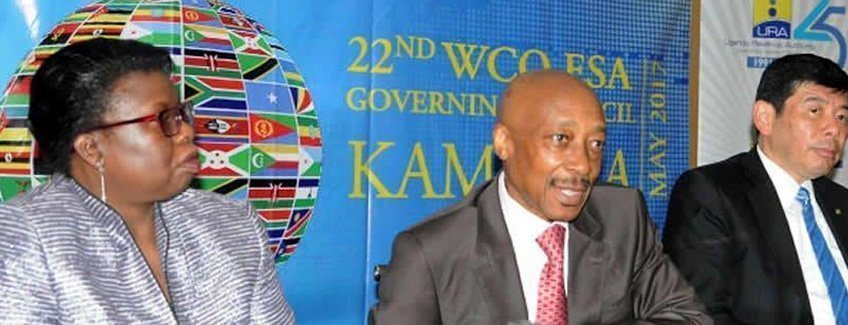
Kunio Mirukiya, the secretary general of World Customs Organisation Africa notes that “infrastructure and borders systems are key in facilitating movement of goods and people. Customs should coordinate border management, have one stop border post or a single window and more security by collaboration is what Africa should be looking at.” He made the remarks during the 22nd World Customs Organisation East and South Africa Council governing meeting in Kampala on 12th May 2017.

Africa needs to trade more with itself. Local markets should be the first point of sale for indigenous manufactured goods if African economies are to improve revenue collections and enhance job creation.

However, statistics show a grimy face. The bulk of the Africa’s trade is with Europe and America: only 12% is with its own countries, according to research by Ecobank, a Togo-based bank. By comparison 60% of Europe’s trade is with its own continent. The same is true in Asia.

Africa’s trade looks all the more meagre given that many of its countries are landlocked; so much of what crosses its internal borders is on its way to or from other continents. African market remains highly fragmented.

Poor infrastructure is one reason for Africa’s sclerotic trade. The continent’s multiple trade agreements are another hindrance. Africa has 14 different trading blocs with overlapping members. Most countries belong to at least two blocs. Many belong to three. Yet traders find a way around such barriers.

Many other goods move across borders but elude the customs inspectors who record official trade flows. There are informal trade routes that are well established. Somali traders based in the Eastleigh area of Kenya’s capital, Nairobi, (known as “Little Mogadishu”) import rice, sugar and consumer goods into Dubai, tax-free, and then distribute them around east Africa. There is a similar dodge in West Africa. Imports are shipped into Benin and Togo and spirited across borders to consumers in neighbouring.


0 comments

Leave a comment

Keep reading

More from Summit Consulting.