
A poorly written report means that the case is likely to drag on because the facts are not clear. A weak report does not empower management or court with full facts on the case to objectively reach the right decision for the effective administration of justice.
Are you confident about the quality of your investigations or fact-finding reports?
Can your reports withstand detailed scrutiny by an opposing counsel?
Do you know how to present evidence in your written reports?
Why is it called a fact-finding report?
All investigation assignments have one objective: To determine who did WHAT, WHERE, WHEN, HOW, and WHY. As an investigator or fraud examiner, you must provide answers supported with watertight evidence. It is not acceptable to write an opinion or hearsay in an investigation report. For that reason, we call the outcome of any investigation, a “Fact findings report.” It is a report of facts about the matter at hand. That is why no single investigation is the same.
Why investigate? You want to find the following answers:
WHO?, The suspects are usually different.
WHAT?, The issue at hand or the crime is typically different.
HOW?, The method or approach or modus operandi on how the crime was committed is usually different.
WHY?, The reasons for the crime or motive of the criminals or intent are usually different.
WHEN?, The timing of the crime is usually different.
WHERE?, The location of the crime scene is usually different.
Because no single case will have all these facts the same, no investigation is the same.
What makes a competent Fraud examiner or Investigator?
You got it right, the quality of the output of the investigation work. A great investigator writes a great investigation or fact-finding report. For example, there cannot be draft evidence. For that reason, investigation reports cannot have the word “draft” on them. The word “draft” is something most auditors love to write on their reports.
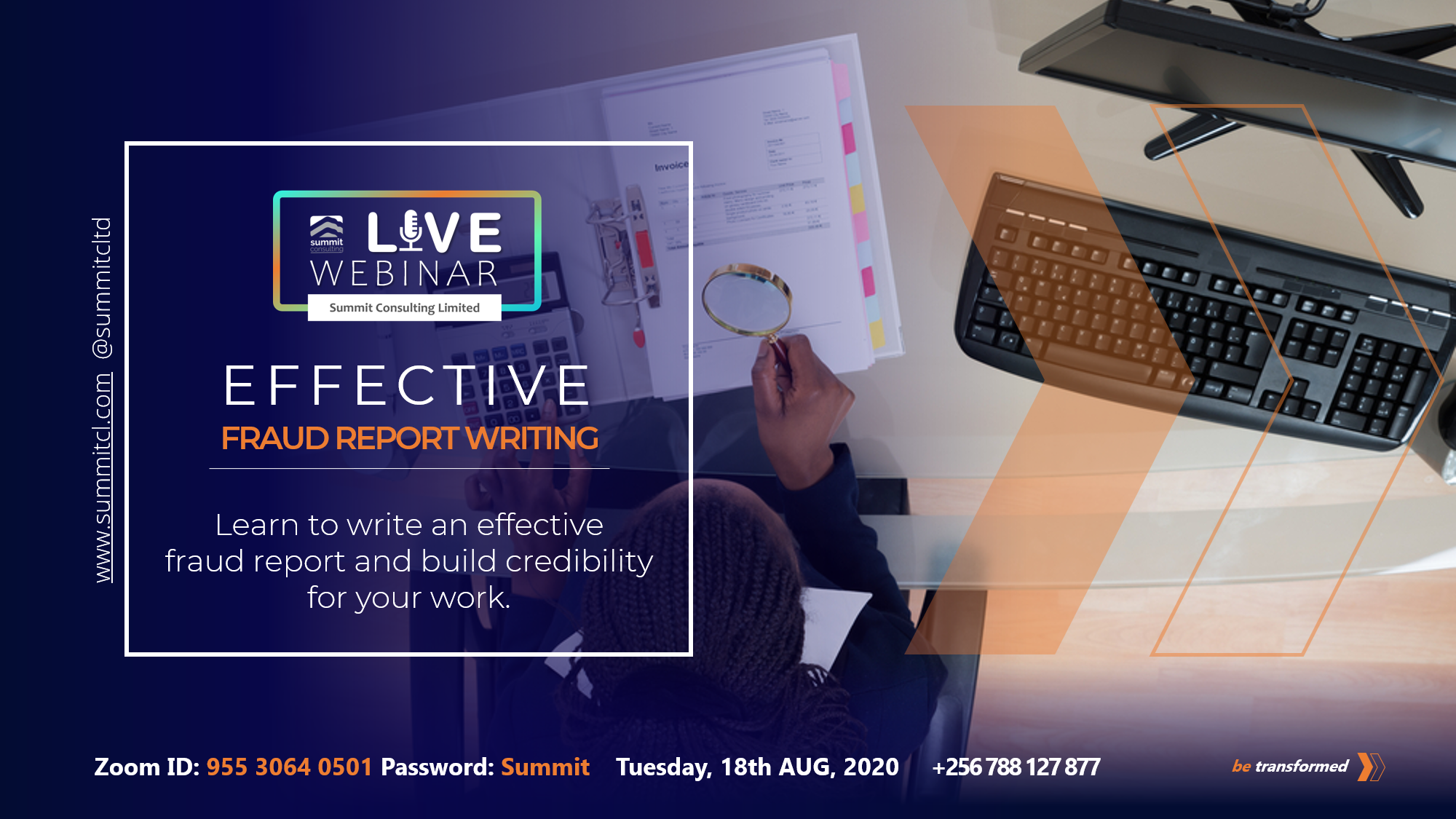
In line with the above, Summit Consulting Limited cordially invites you and your team to our introductory training on Effective Fraud report writing.
When: 18th August 2020 at 12:00 noon, 1:00 pm
Where: Via Zoom
Fee: Ugx. 100,000 only. However, if you register before 12th August 2020, you will pay only 50% of the fee. If you are a Police Officer or in national service like IGG, DPP, Judiciary, etc., or non-government government organization (NGO) and have an ID, register and attend FREE of Charge.
By the end of this training, you will learn the art of investigation report writing and become a darling of your company’s Top Management, Lawyers, and Court.
As a bonus, you will receive a free download of our Theft and Fraud Investigation Report Template in an editable MS Word version. This template will improve the quality of your reporting and work. Remember, never put a label like DRAFT Report in a fraud investigation report. The reason, there cannot be draft evidence.
Contact us for customized inhouse training on Effective report writing.
The training is ideal for the following:
- HR practitioners
- Lawyers
- Investigators and fraud examiners
- Police officers
- Auditors, internal or external
- Finance professionals and accountants
- Prosecutors
Register below to attend the next class
See you there.
Copyright Summit Consulting Ltd, 2020. All rights reserved.



0 comments
Leave a comment