

Most CEOs have a ritual before a board meeting. They open the performance dashboard, look for the green arrows, pause at the red ones, ask the CFO why one number is below budget, and then walk into the boardroom feeling reasonably confident because deposits are growing, loans are growing, and profit is ahead of last year.
I have witnessed this ritual many times. The problem is that a bank can close every KPI ring and still be walking in circles. It is like the executive who celebrates closing all the rings on his smartwatch after spending the day walking between airport lounges. The device is correct. He moved. The harder question is whether he went anywhere useful. That is one of the strategic problems facing Uganda’s largest banks today.
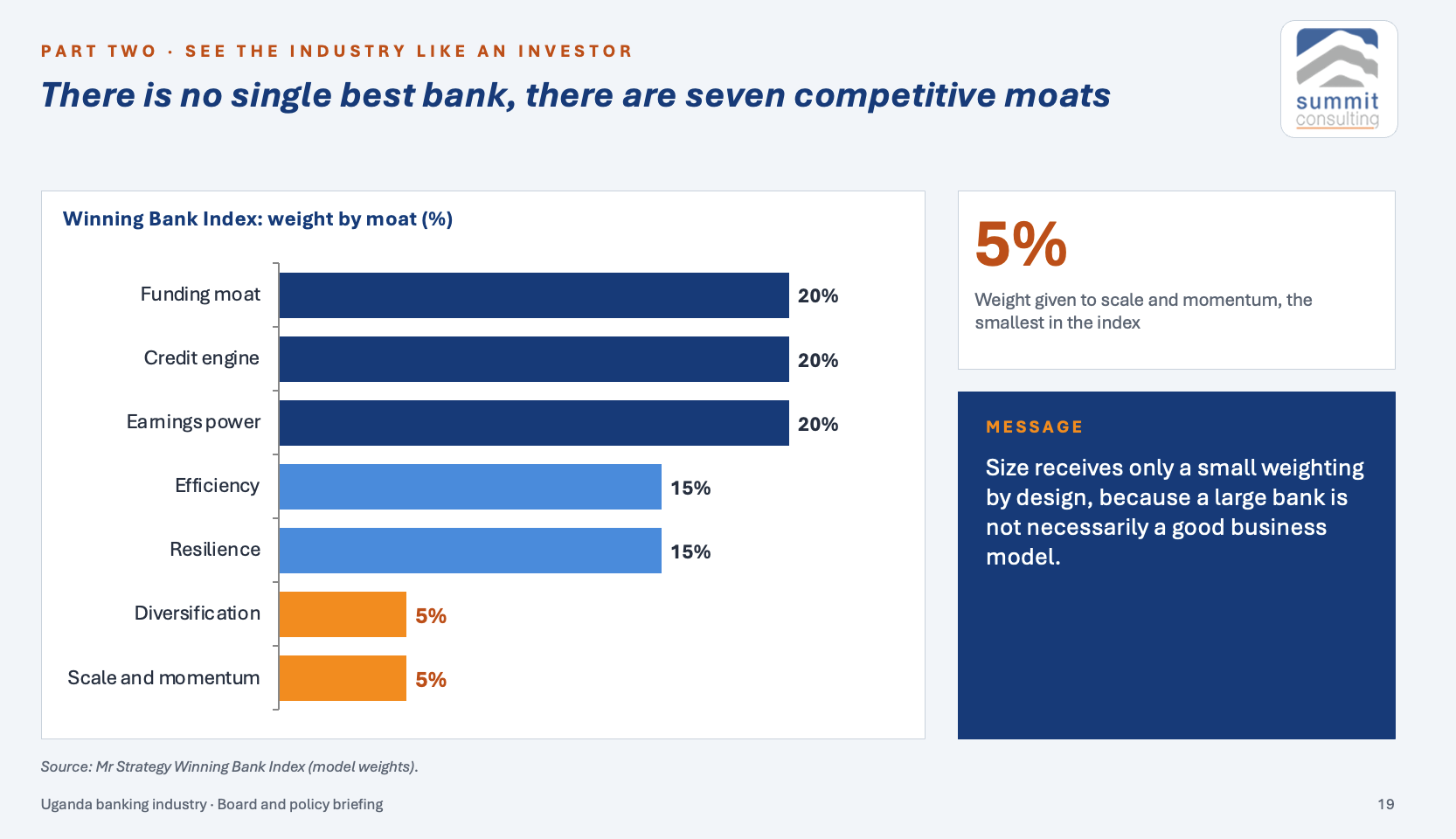
Stanbic, Centenary, Absa, DFCU, Housing Finance and Equity are all growing, recovering or repositioning, but they are not really competing in the same business anymore. They are building different economic machines, and the bank that wins the next five years will not necessarily be the one with the largest balance sheet, the most branches, the loudest digital campaign, or even the highest profit growth.
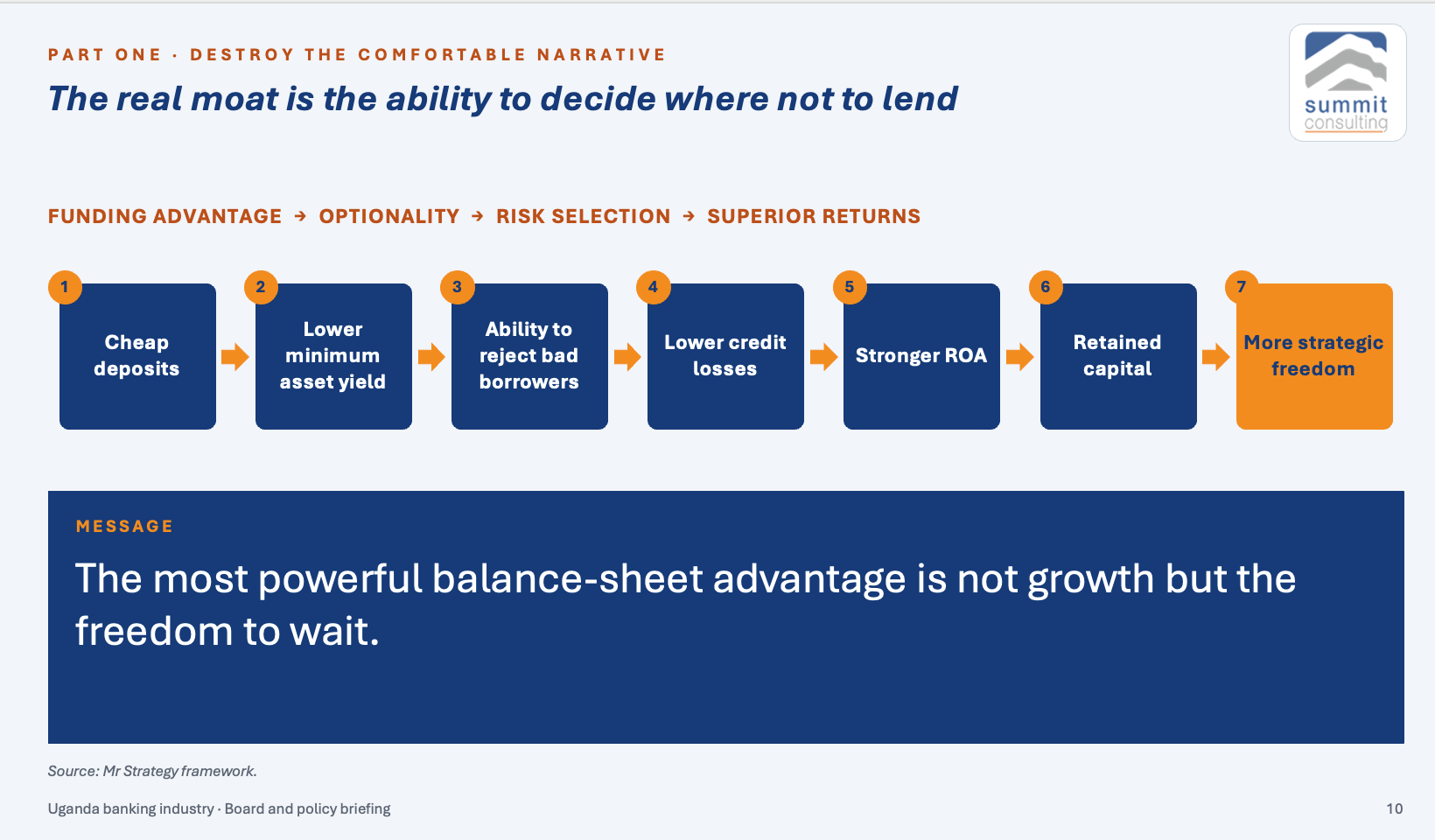
The winner is the bank with the greatest freedom to decide where the next shilling goes.
That freedom comes from cheap funding, superior customer information, disciplined risk selection, low operating friction, and the ability to earn revenue from an ecosystem rather than from a loan alone. That is where Uganda’s banking profit pool is moving.
The industry looks strong, but the balance sheet is telling another story
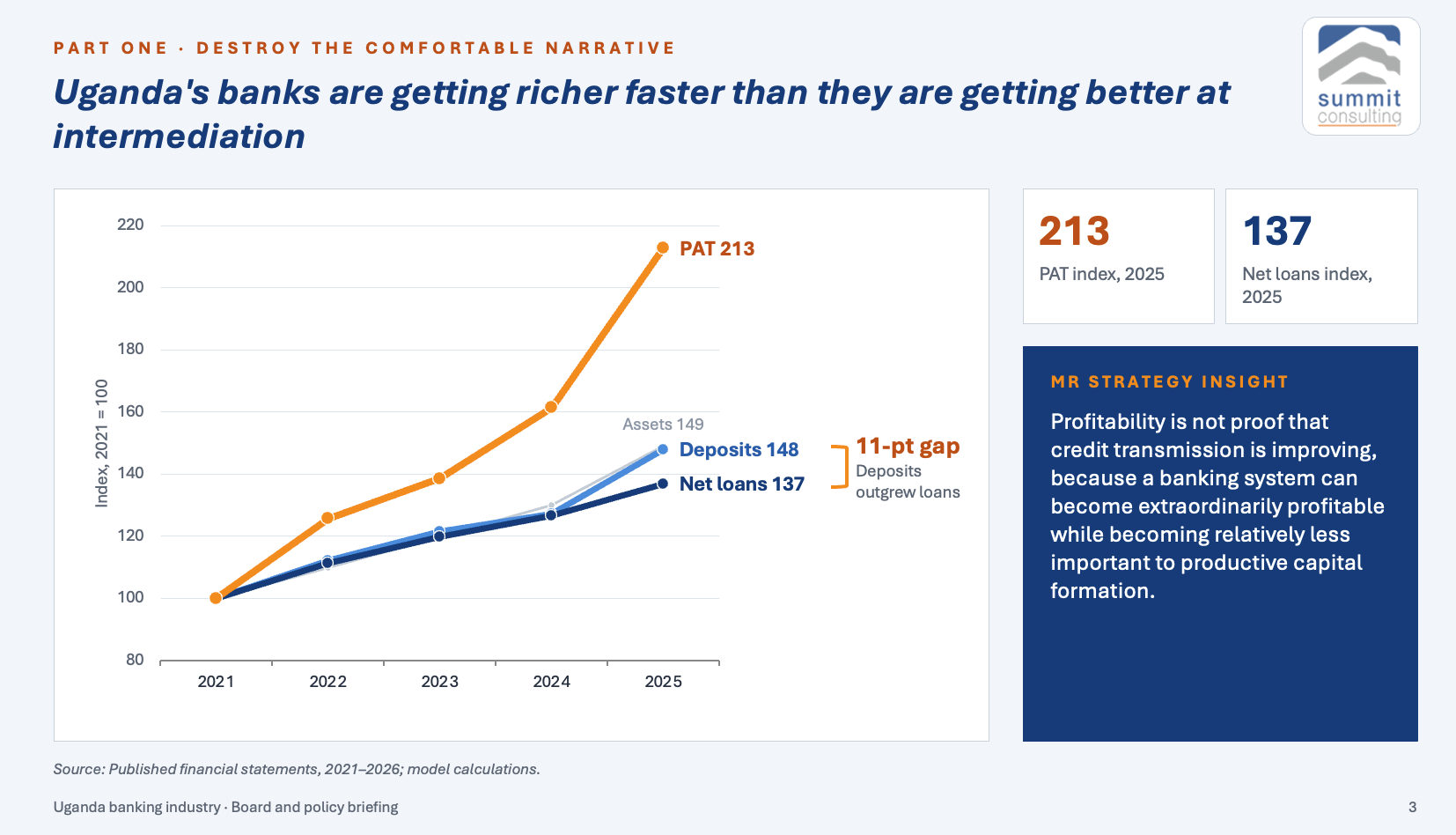
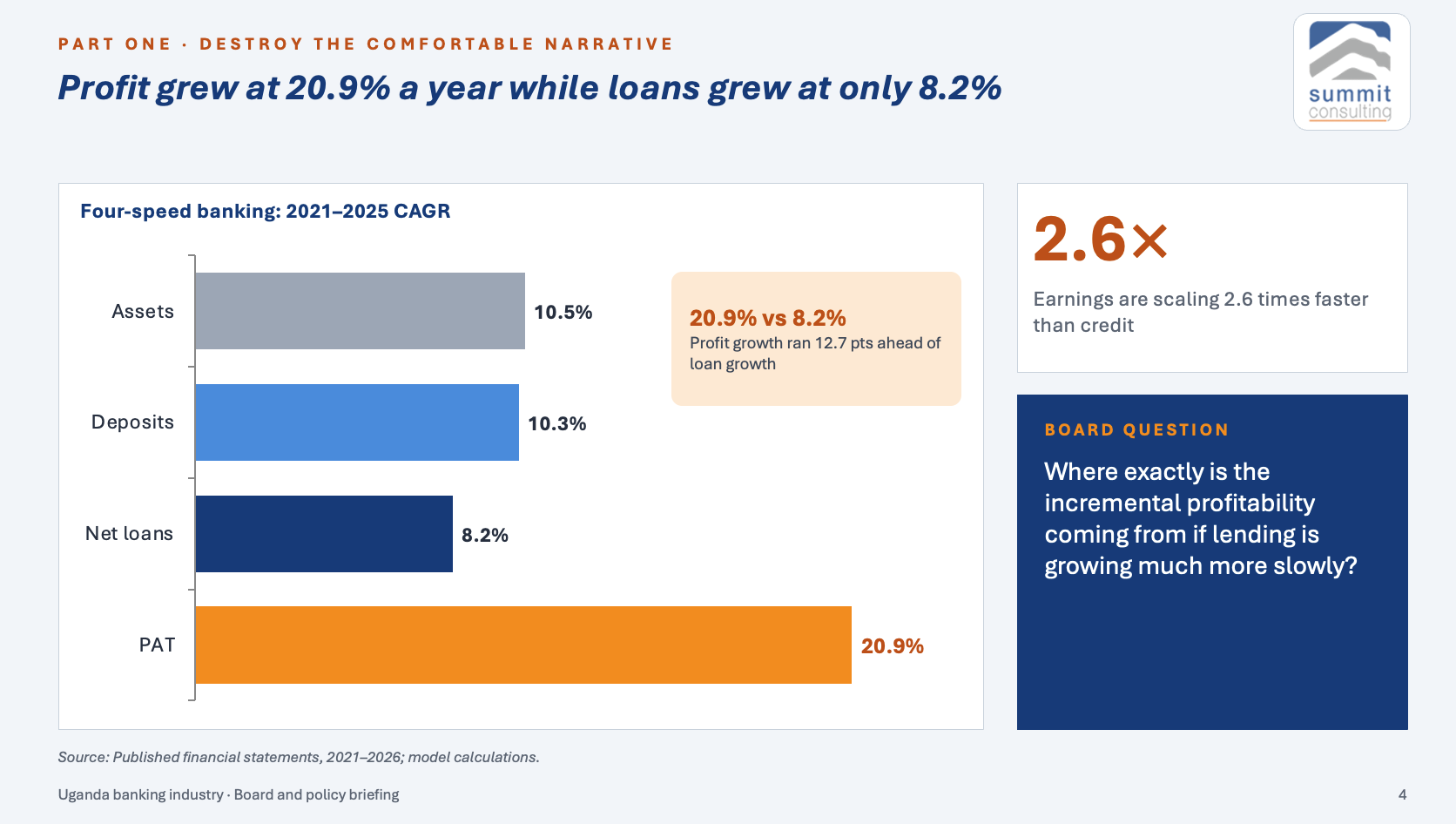
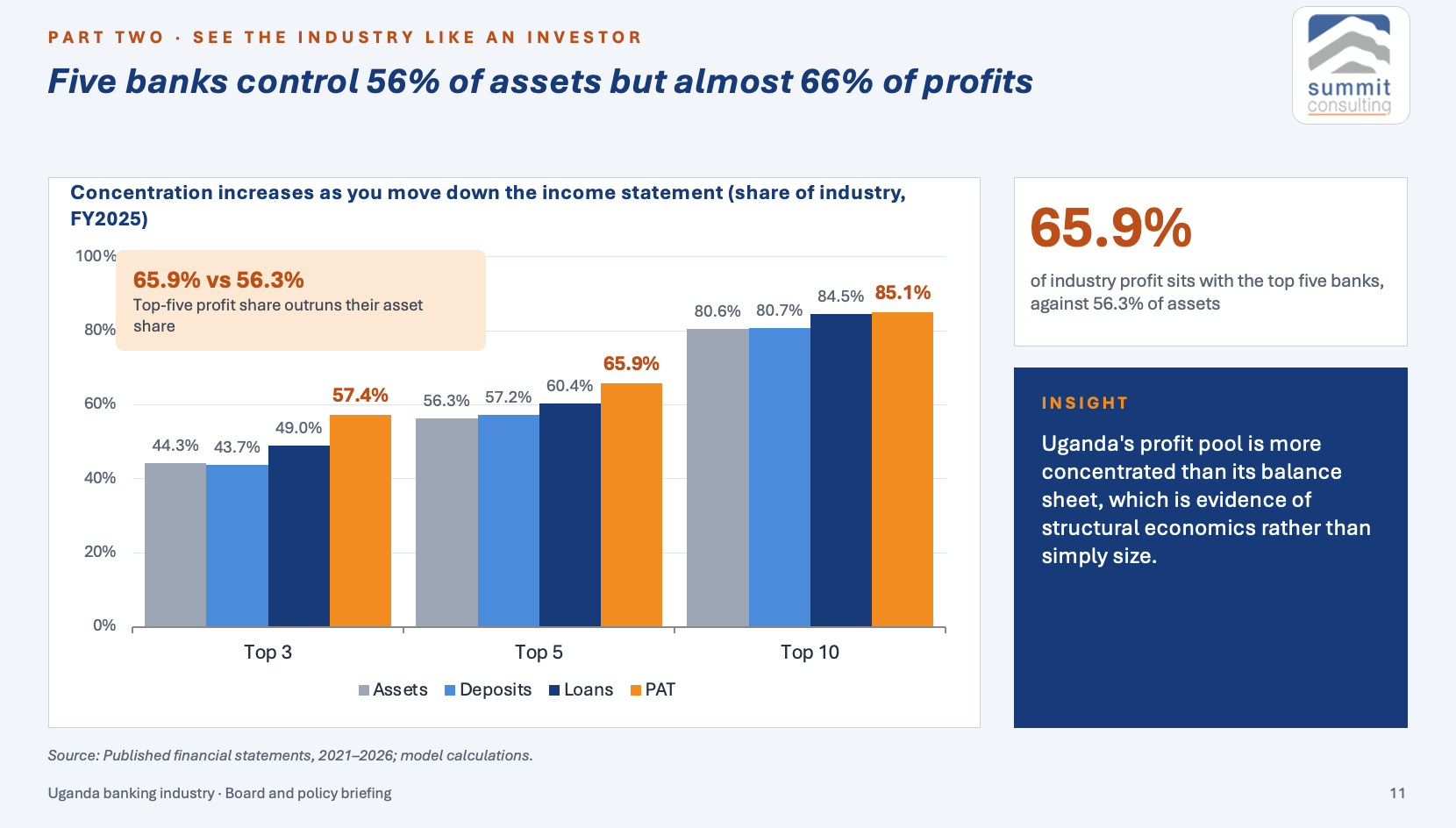
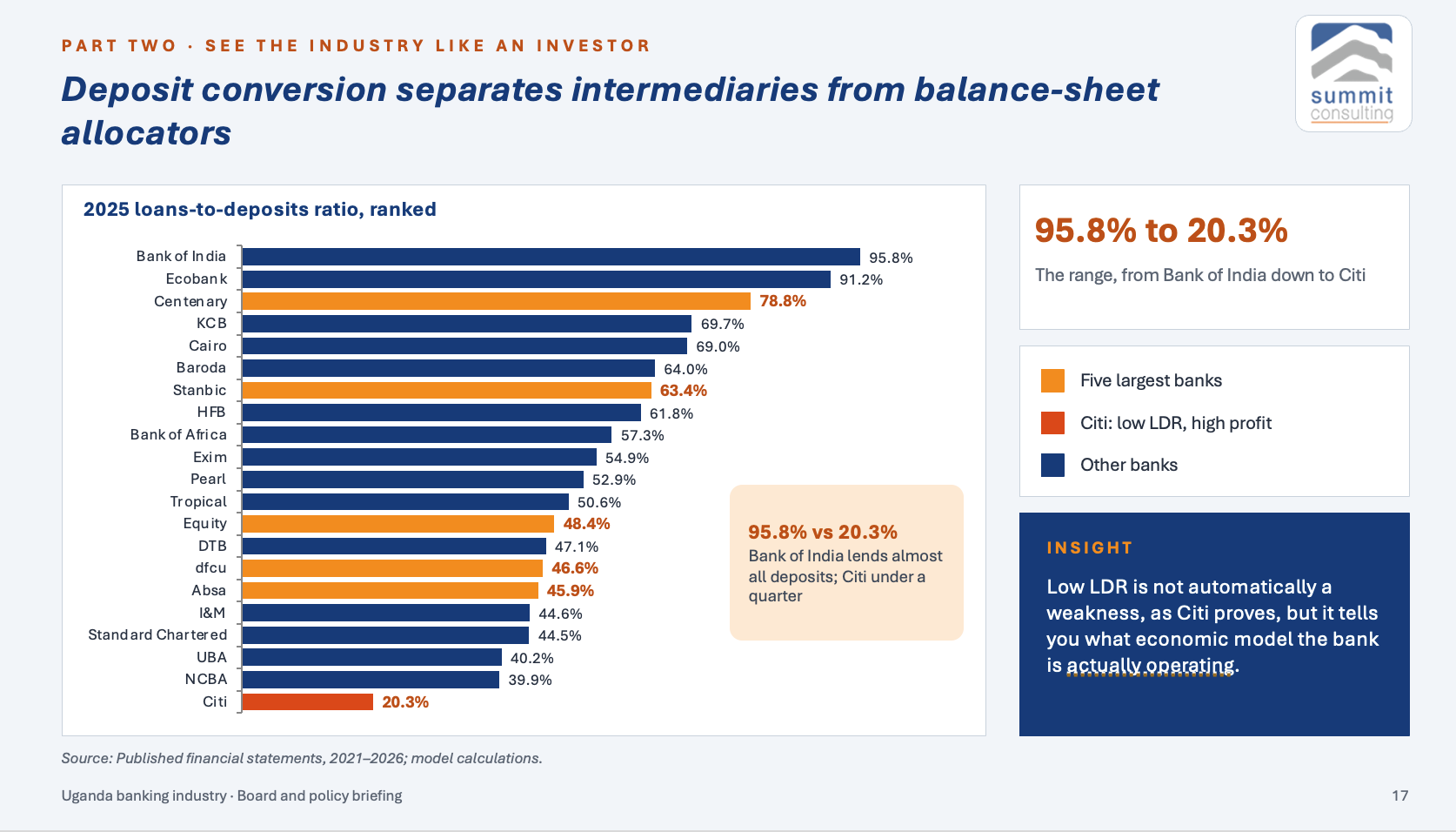
The FY2025 published financials in the summitBI industry model show approximately UGX 60.9 trillion in banking assets, UGX 41.1 trillion in customer deposits and only UGX 23.2 trillion in net customer loans, with industry profit after tax around UGX 2.1 trillion.
The gap between deposits and customer loans was therefore approximately UGX 17.9 trillion.
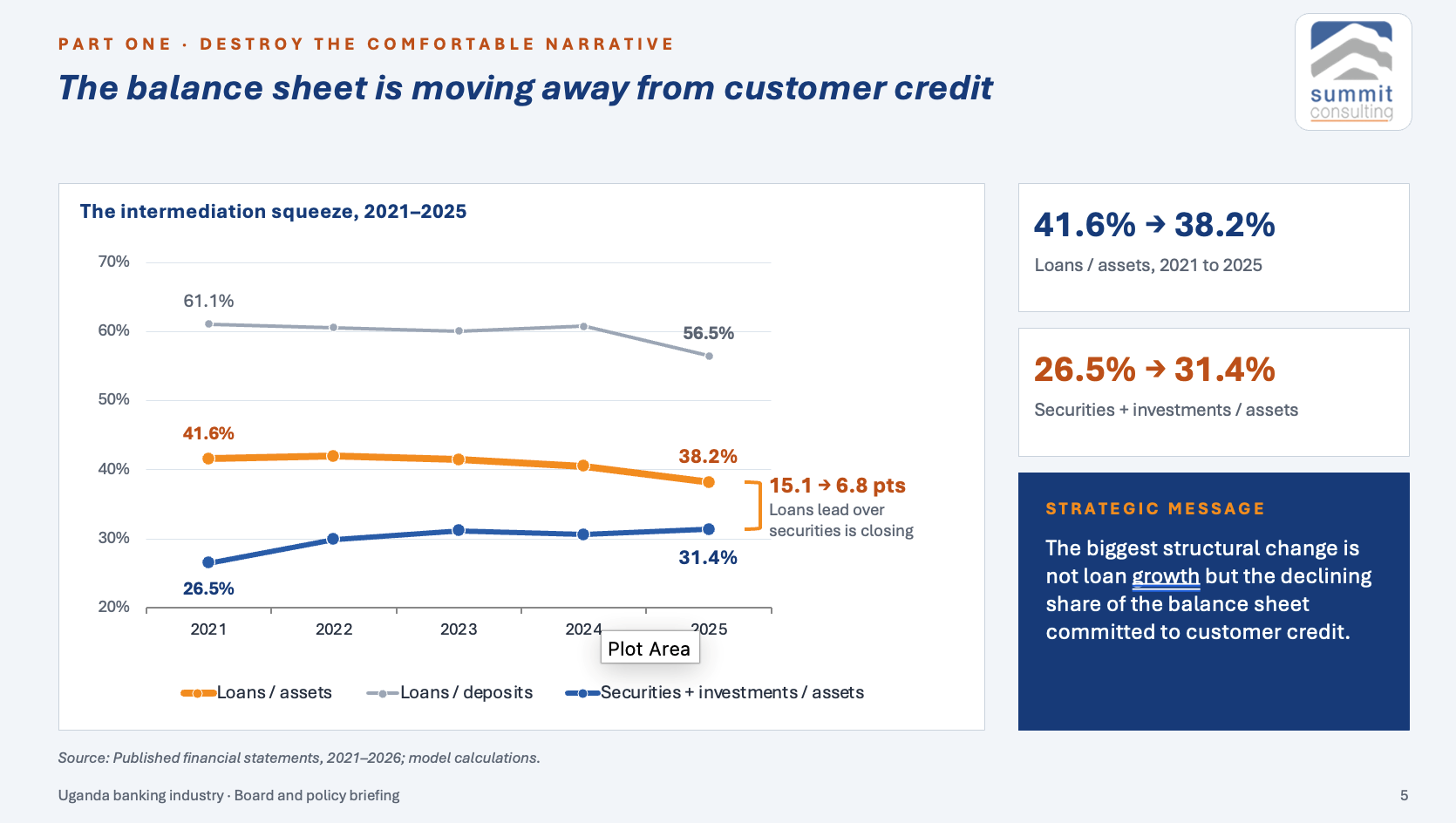
That money is not idle. Banks hold cash, interbank assets, liquidity buffers, investment securities and government paper. But the strategic point remains: Uganda is exceptionally good at mobilising financial savings compared with how much of those savings commercial banks convert into customer credit.
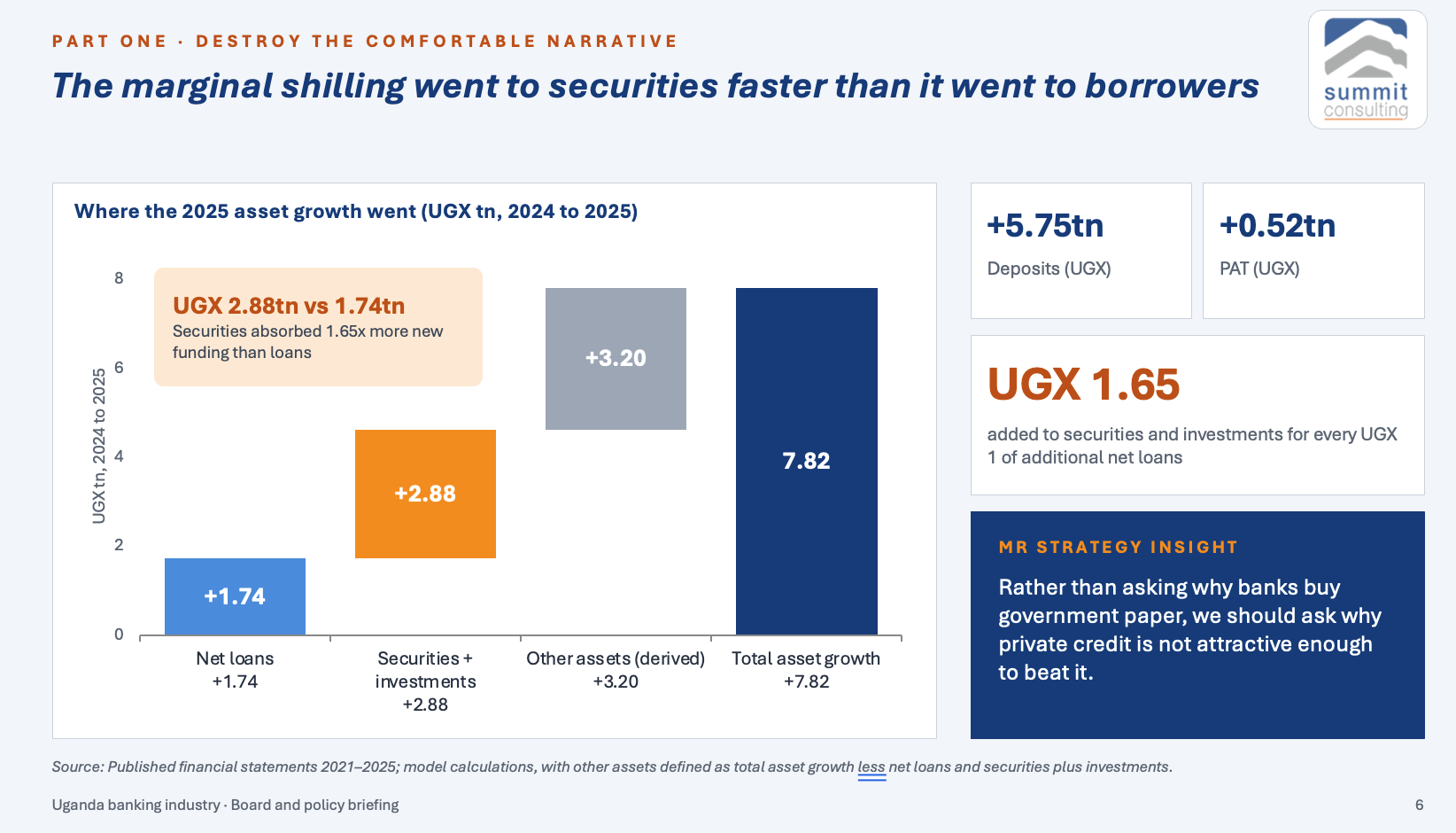
The latest Bank of Uganda data make the tension even clearer. By June 2026, commercial-bank assets had reached UGX 71.7 trillion, while central-government securities alone had risen to UGX 20.3 trillion from UGX 17.3 trillion a year earlier. Total loans were UGX 30.9 trillion. This is not banker laziness. It is capital allocation.
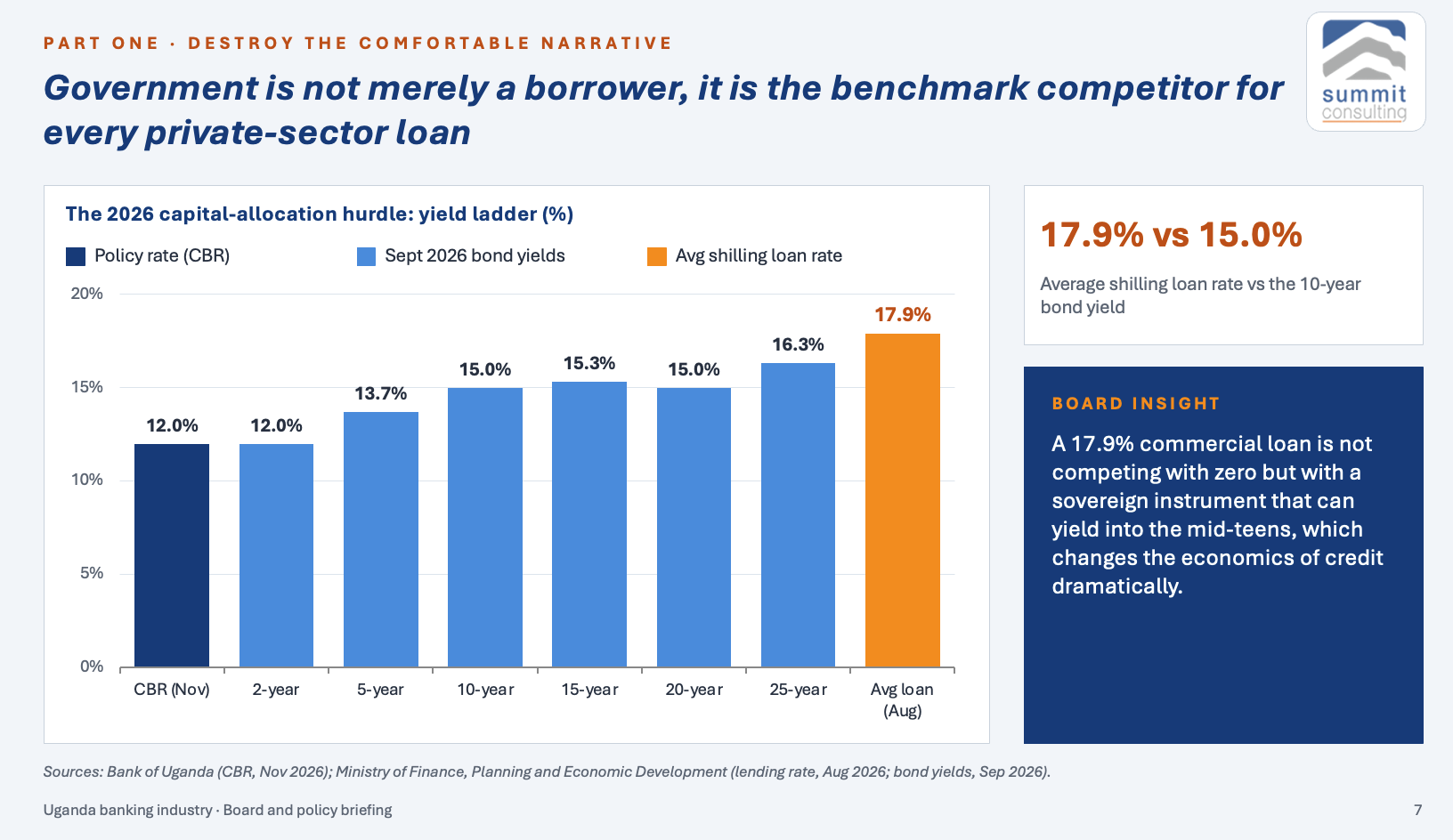
The IMF has warned that the sovereign-bank nexus is becoming structurally important, with banks’ claims on government rising to about 65 percent of claims on the private sector in 2024, up from 44 percent in 2019. Now add the environment banks are entering at the end of 2026. Bank of Uganda increased the Central Bank Rate from 9.75 percent to 12 percent on 14 October 2026, while the cash reserve requirement was also raised to 13.5 percent amid exchange-rate and energy-price pressure.
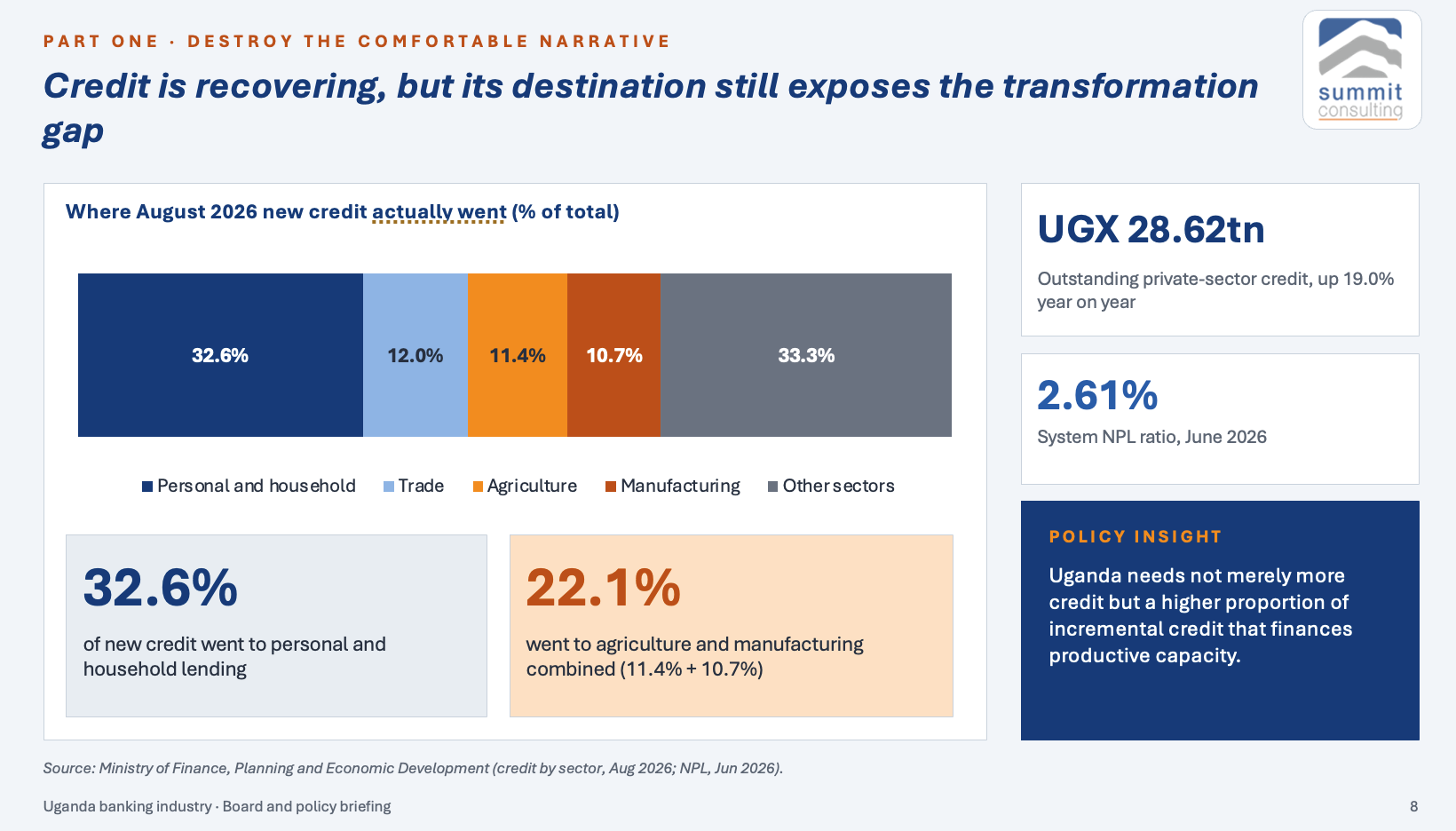
So, Board members, policy makers and dear business people understand the mathematics. You are asking management to finance manufacturing, agriculture, exporters and SMEs more cheaply at the same time that monetary conditions have tightened and government securities remain highly competitive.
The challenge is not to simply “grow the loan book”. It is to find assets that beat the sovereign alternative after funding cost, expected loss, operating expense, liquidity, and capital consumption. That is a much harder game. Let’s dig deep into each top contender to understand what informs their game plan.
Stanbic: the problem with having the best seat in the room
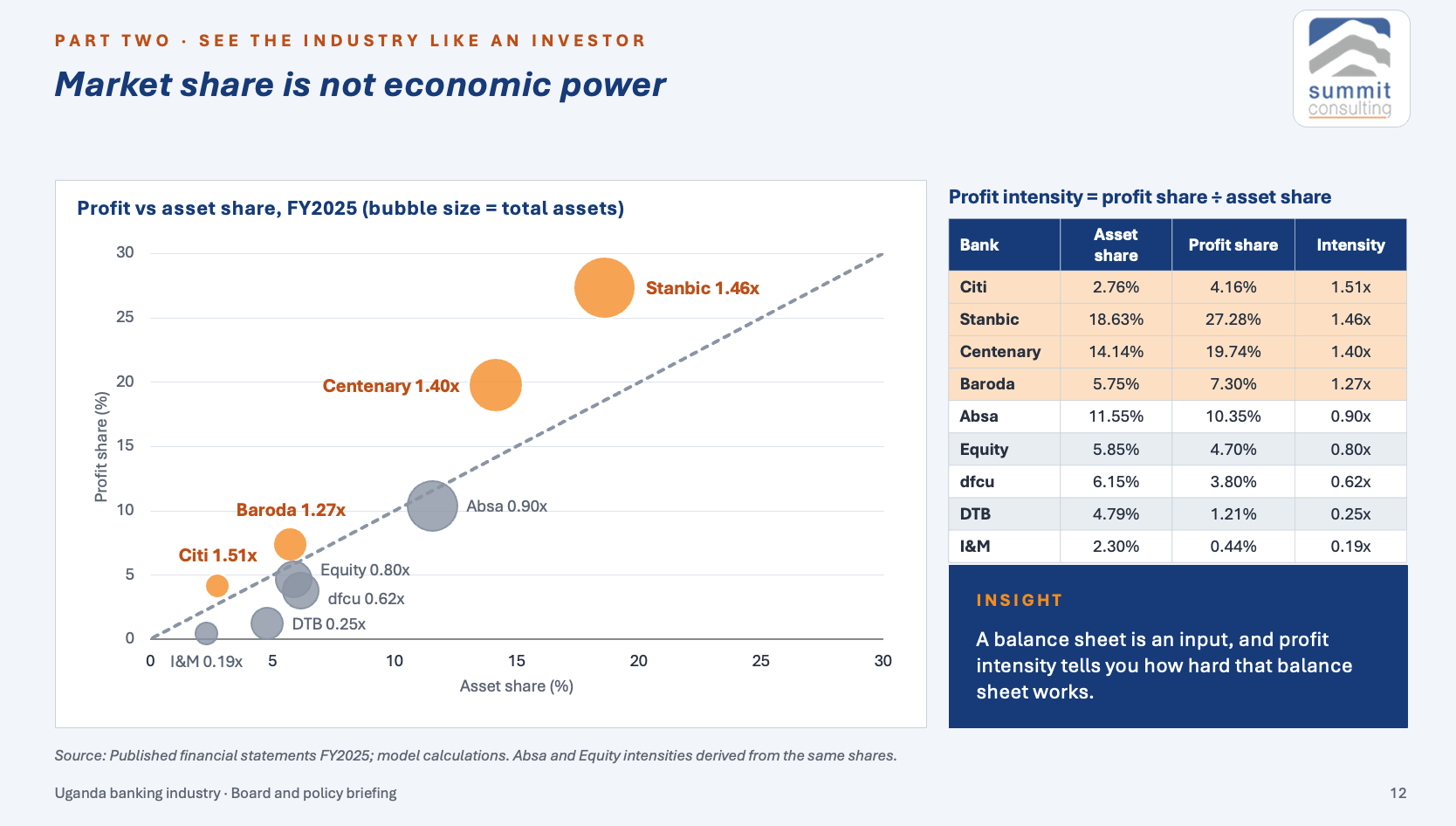
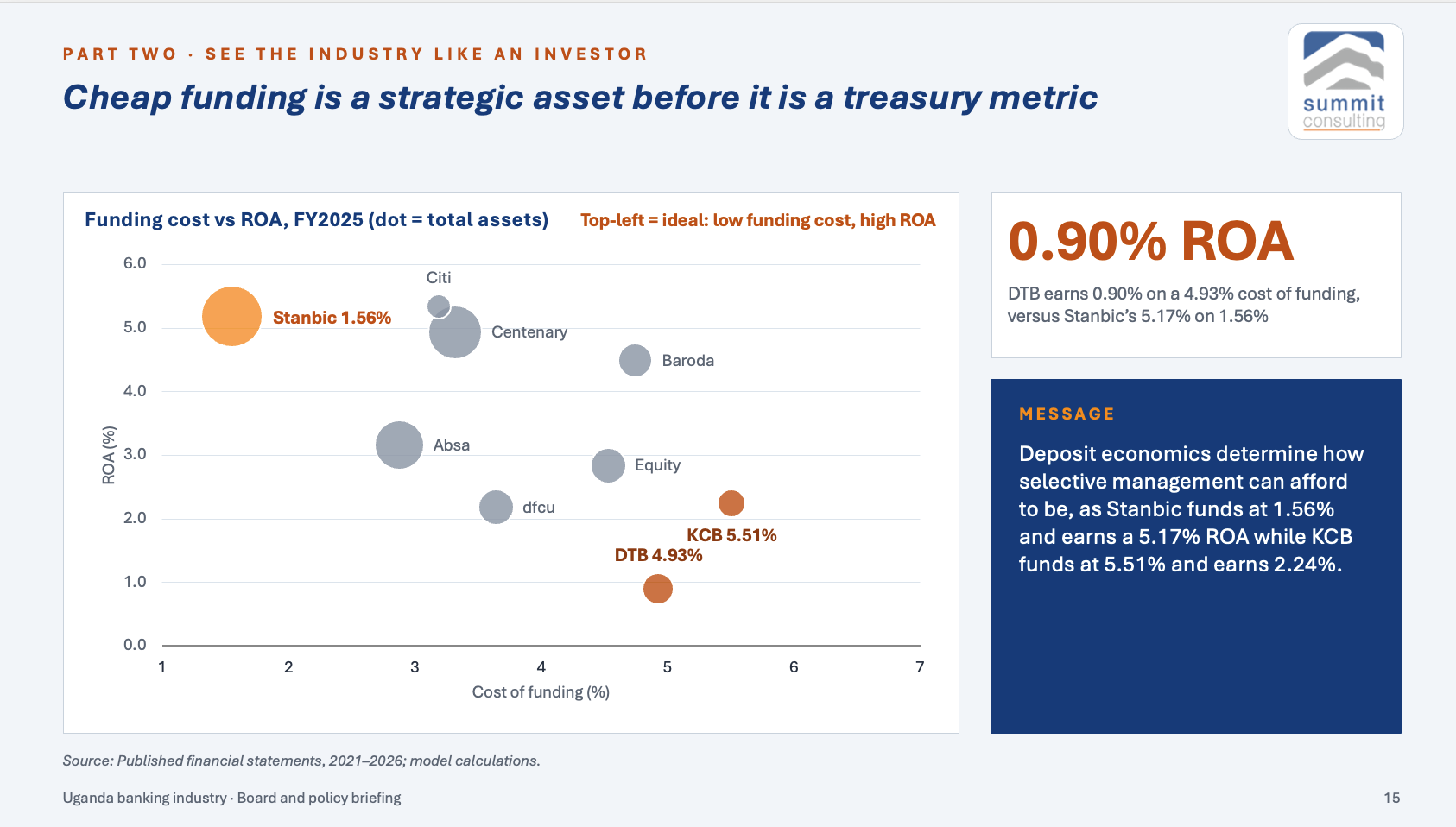
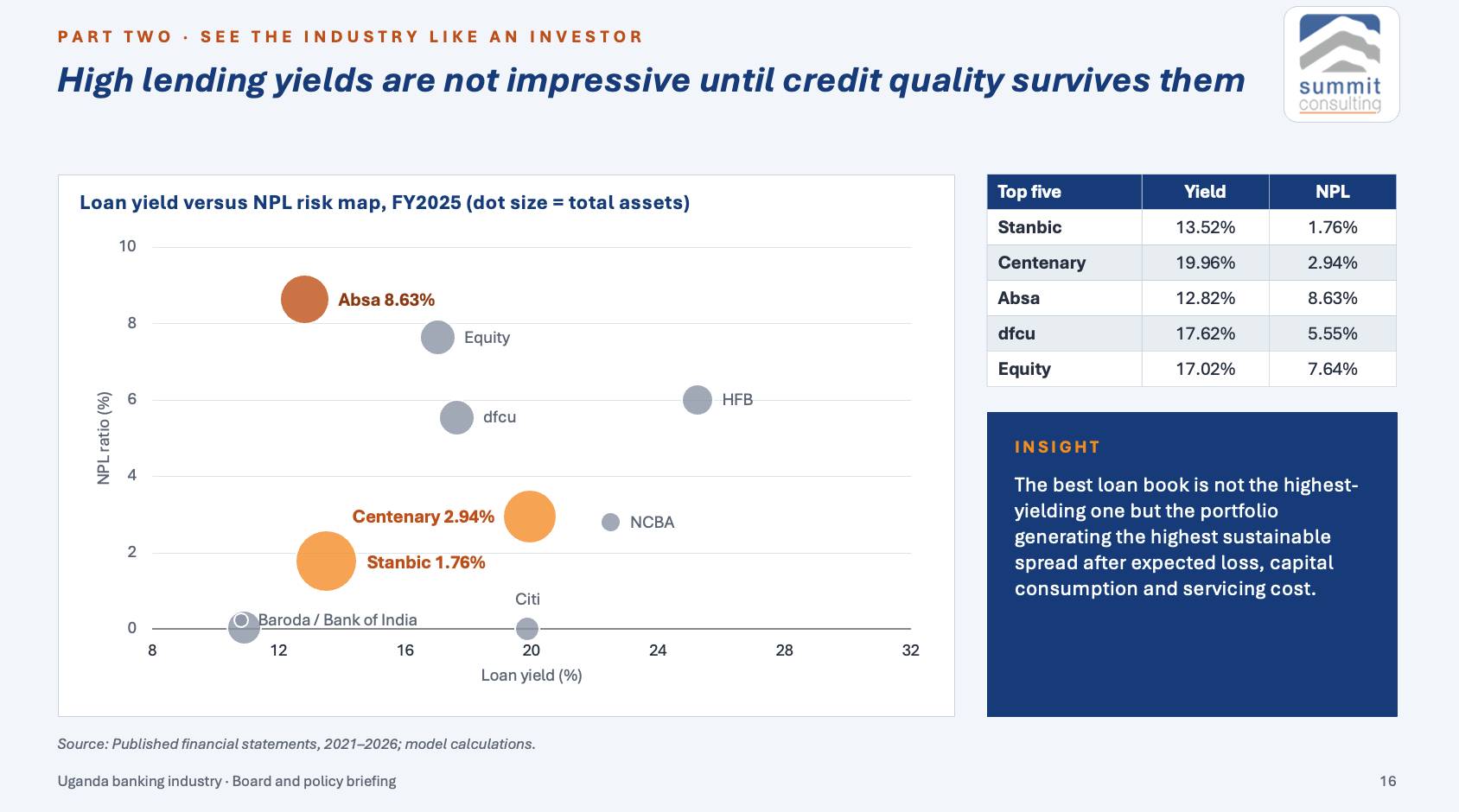
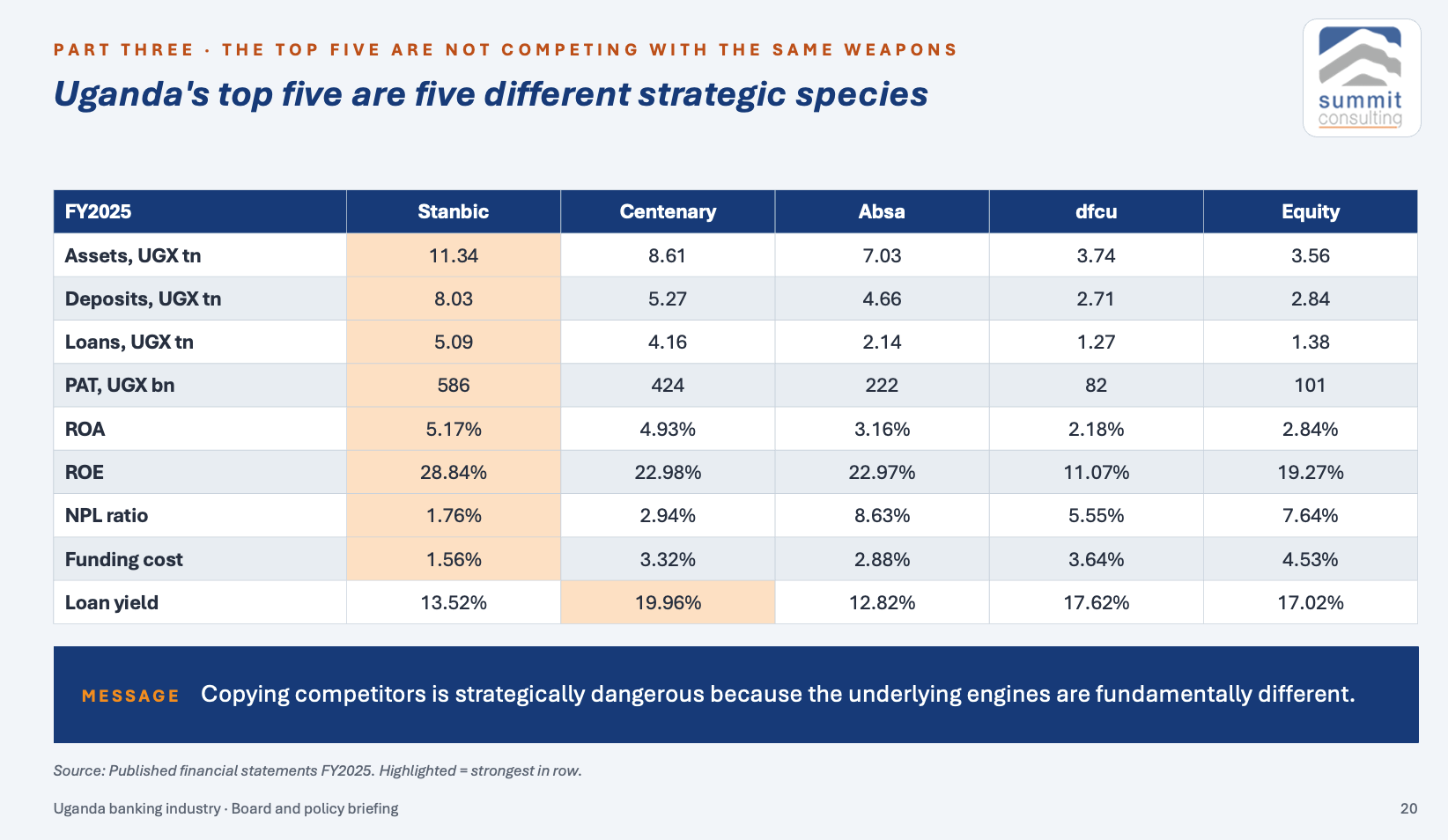
Stanbic remains Uganda’s most formidable banking franchise. Its 2025 numbers explain why. Total assets were approximately UGX 11.5 trillion, customer deposits UGX 8.0 trillion, and customer loans UGX 5.1 trillion. Return on average assets reached 5.4 percent, return on average equity 26.8 percent, cost-to-income was 47.1 percent, and the NPL ratio was only 1.7 percent.
Profit after tax was approximately UGX 586 billion at bank level in the published statements, with the broader holdings structure reporting roughly UGX 591 billion.
By the first half of 2026, Stanbic was still accelerating, with net profit of UGX 357 billion, customer deposits of UGX 9.2 trillion, loans of UGX 5.3 trillion, and ROE around 30.4 percent.
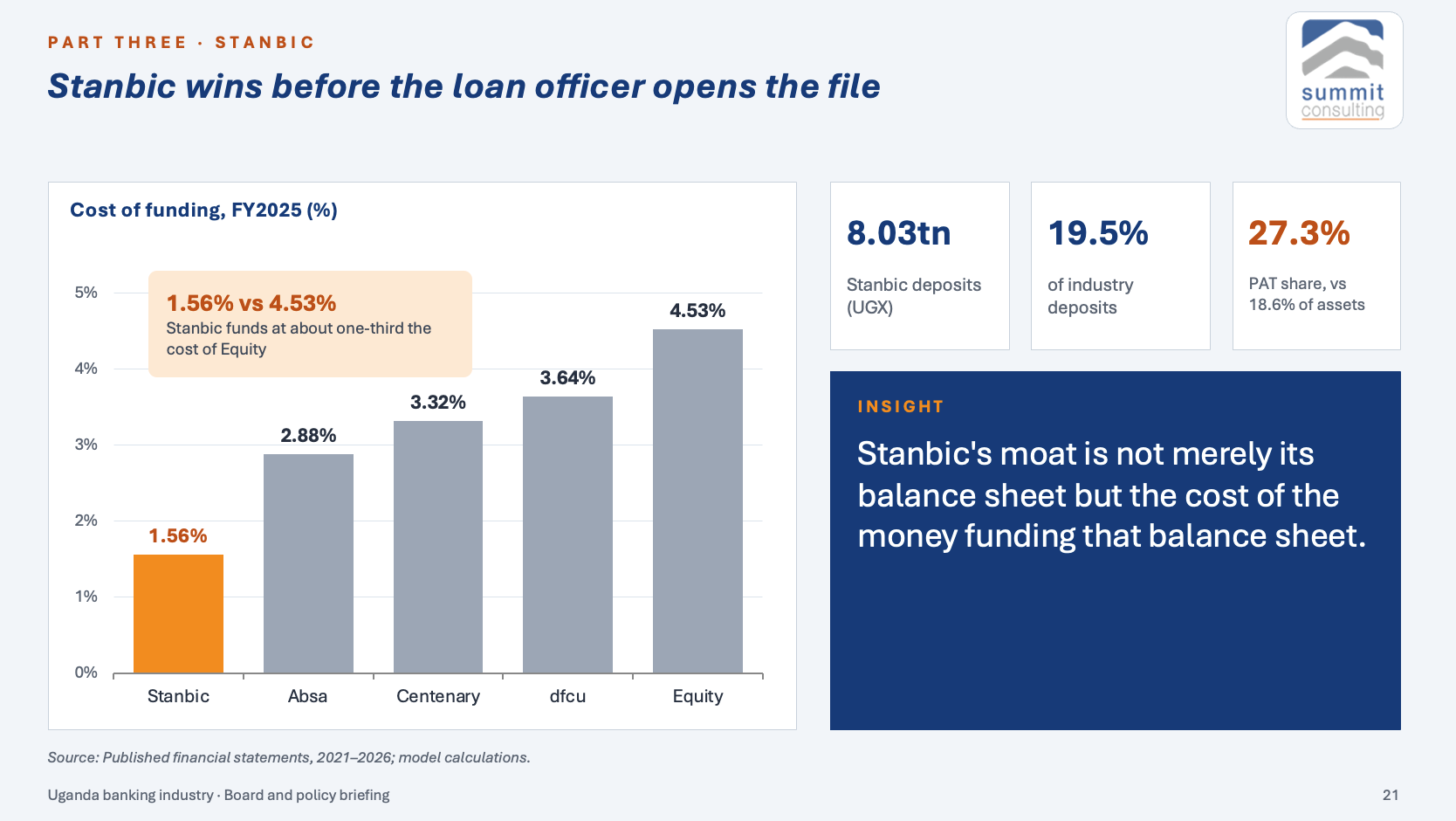
This is what structural power looks like. Stanbic has customers and the flows: Corporate payments. Institutional deposits. Salary relationships. Foreign exchange. Trade finance. Large commercial ecosystems. Transaction banking.
These activities create deposits before management even begins thinking about loans. That gives Stanbic a luxury smaller banks rarely enjoy: it can say no. A bank with expensive deposits must find yield. Stanbic can wait for quality. But that strength creates Stanbic’s biggest strategic risk. Comfort.
When your funding architecture is this powerful and your risk indicators are this clean, simply remaining number one is not a sufficiently ambitious strategy.
The board should be asking a harder question: is Stanbic converting its structural funding advantage into enough productive economic leadership?
Its loans grew 16.4 percent in 2025, faster than deposits, which is encouraging. But the bank’s strategic opportunity is larger than lending growth. It can organise entire ecosystems around infrastructure, agro-processing, energy, exports, oil and gas, technology and industrial value chains.
The danger is that the market changes from balance-sheet banking to ecosystem banking while the market leader continues optimising an already excellent machine. Leadership can become a moat. It can also become a mattress.
Centenary: the bank that knows the customer everybody else studies in PowerPoint
Centenary is a completely different animal. In 2025, total assets grew 21 percent to UGX 8.61 trillion, deposits increased 25.1 percent to UGX 5.27 trillion, loans rose 11.9 percent to UGX 4.16 trillion and profit after tax increased 23.9 percent to UGX 424.2 billion. Its NPL ratio remained relatively contained at 2.94 percent.
But those numbers do not explain the moat.
Customer knowledge does.
More than 77 percent of Centenary’s customers were classified as coming from underserved segments in 2025, while its MSME and agriculture portfolio reached about UGX 1.76 trillion. The bank also reported that agents accounted for 49 percent of transactions. That is strategically important. Many banks approach a farmer, micro-enterprise or informal trader as a credit problem requiring collateral. Centenary has spent decades treating the same customer as an information problem. It knows seasons. It knows cash cycles.
It understands small-ticket behaviour. It understands church communities, rural markets, cooperatives, trading centres, farmers and family businesses in a way that cannot be reproduced by purchasing new software. That accumulated knowledge is an intangible asset. What ails Centenary is therefore not demand.
It is the cost and complexity of carrying its distribution advantage into the next era. A large branch and human network once created access. Today, the strategic question is whether that network can become a low-cost data network.
If digital investment simply sits on top of branches, staff, manual workflows and legacy processes, the bank will digitise its cost base rather than transform it.
The future Centenary must therefore preserve what competitors cannot easily copy, its knowledge of the mass-market borrower, while removing what technology can replace: friction, manual processing, repeated paperwork and expensive transaction handling. That is transformation. Not launching another app.
Absa: the most strategically interesting bank in the top five
If I were sitting on the Absa board today, I would not spend much time celebrating the Standard Chartered transaction. I would ask what exactly we have bought.
Because Absa has just moved from a growth story into an integration story.
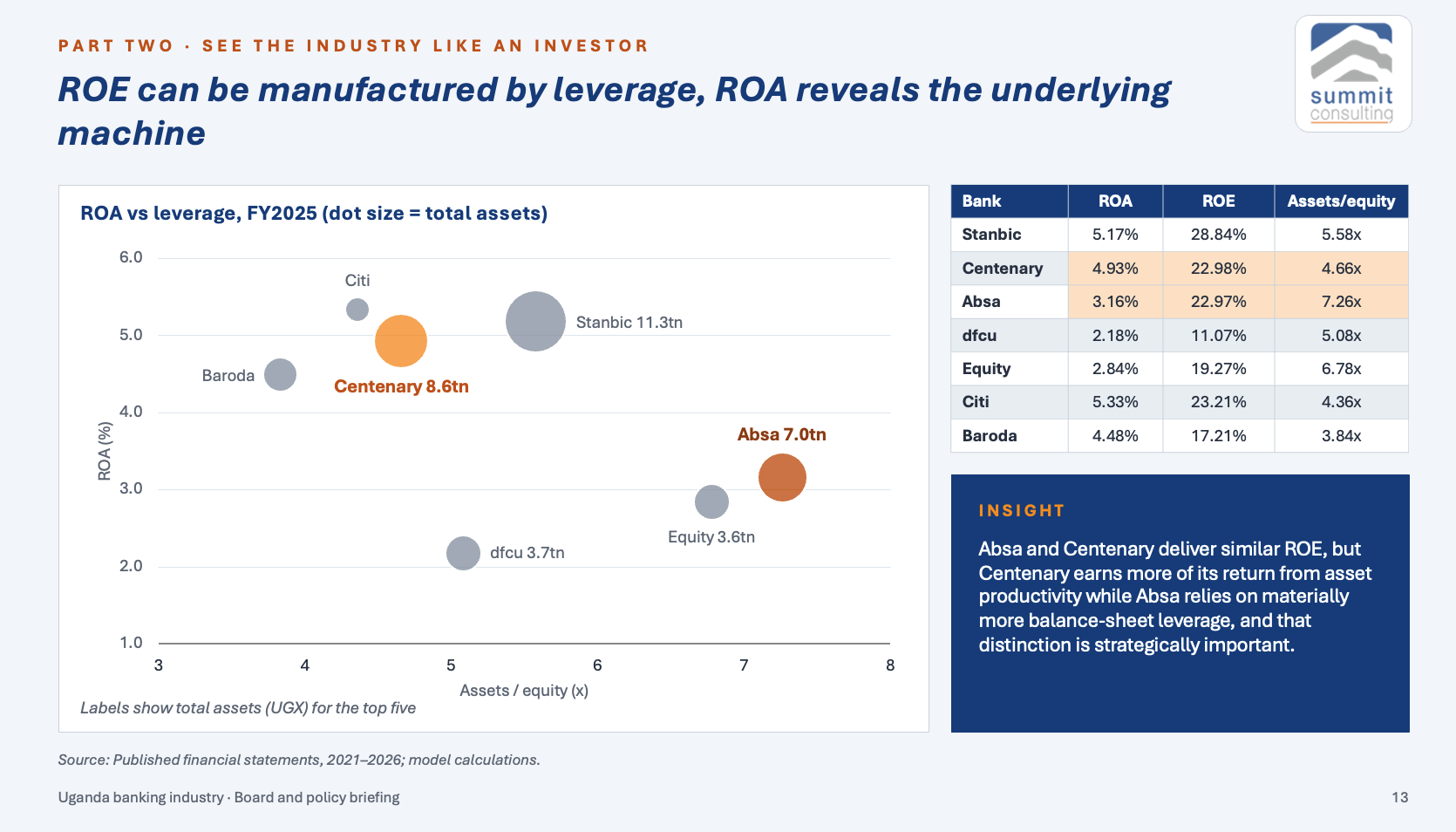
Its 2025 assets grew by roughly 29 percent to UGX 7.03 trillion, customer deposits surged 46.4 percent to about UGX 4.66 trillion, and profit after tax rose around 25 percent to UGX 222 billion. Yet lending grew far more slowly, around 7 percent in the comparable published data.
That is already an unusual balance-sheet signal. Then Standard Chartered’s Wealth and Retail Banking business transitioned to Absa in November 2026, transferring an established retail and wealth franchise into a bank whose deposit engine was already expanding aggressively. Standard Chartered now confirms that its Uganda Wealth and Retail Banking business has transitioned to Absa. This could be one of the most consequential transactions in recent Ugandan banking.
Why?
Because Absa did not merely buy accounts. It acquired customer relationships, wealth balances, mortgages, salary flows, cards, transaction behaviour, and years of relationship history.
That is funding and data.
But acquisitions have an ugly habit. They look strategic on signing day and operational six months later. Absa must therefore avoid becoming a larger warehouse for deposits.
The real prize is turning the acquired franchise into deeper household economics through mortgages, investments, insurance, cards, SME relationships, payments and wealth management without weakening asset quality. This is key because the compiled FY2025 bank data still show asset-quality pressure at Absa compared with Stanbic and Centenary.
So the strategic question is not, “Can Absa grow?” It clearly can.
It is, “Can Absa convert a stronger liability franchise into high-quality earning assets faster than credit losses consume the advantage?”
If it can, the retail hierarchy changes materially.
dfcu: plenty of balance sheet, not enough operating leverage
dfcu is perhaps Uganda’s most interesting unfinished banking story.
The strategic raw materials are attractive.
In 2025, group assets increased 8 percent to UGX 3.72 trillion, customer deposits reached UGX 2.71 trillion and net loans rose about 12 percent to UGX 1.27 trillion. Total income increased to UGX 529 billion, while profit after tax reached UGX 75 billion at group level.
The bank itself reported profit after tax of UGX 81.5 billion, while non-funded income increased 20 percent to UGX 108 billion. More than 80 percent of transactions were occurring through digital channels. That sounds like a transformation story. But the economic conversion remains underwhelming.
Operating expenses rose from UGX 293 billion in 2024 to UGX 332 billion in 2025, while group profit grew only modestly from UGX 72.1 billion to UGX 75.0 billion. That is the problem. DFCU has historical strength in development finance, agriculture, SMEs, women-owned enterprises, corporate banking, and long-term productive sectors.
What it needs is operating leverage.
If revenue grows 16 percent, digital transactions exceed 80 percent, and the bank still struggles to translate that momentum into much stronger shareholder returns, management must ask whether digital transformation is actually removing cost or simply moving transactions away from branches while the underlying operating structure remains intact. That question should make every bank board think.
A digital transaction is not a saving unless something expensive disappears behind it.
DFCU’s opportunity under ATMS is substantial because agriculture, manufacturing, infrastructure, trade and SMEs naturally fit its heritage.
But heritage is not a strategy.
The winning move would be to become Uganda’s specialist productive-economy bank, with deep value-chain underwriting, trade finance, guarantees, asset finance, FX, collections, insurance and supplier finance tied into a few sectors where dfcu can know more than the market. Trying to be everything to everyone would waste its strongest advantage.
Equity: the comeback is real, but the transformation is not yet complete
Equity tells perhaps the most useful boardroom story of the five.
Profit after tax jumped from only UGX 20.1 billion in 2024 to UGX 101.1 billion in 2025, an increase of more than 400 percent.
That headline looks spectacular. But the underlying engine is more revealing.
Deposits grew only about 2 percent to UGX 2.84 trillion, loans increased about 5 percent to UGX 1.38 trillion, and assets increased roughly 5 percent to UGX 3.56 trillion. Non-performing loans, however, fell dramatically from UGX 216 billion to about UGX 105 billion, while the bank swung from a large impairment expense to a credit recovery. That means Equity did not grow its way back. It repaired its way back. That is not criticism. It is good banking.
Sometimes the best growth strategy is to stop leaking. The bank tightened credit, cleaned the loan book, strengthened capital and shifted more resources into securities while rebuilding the institution after earlier fraud and credit-quality problems. But the next chapter is more difficult. You cannot produce another 400 percent profit increase by reversing yesterday’s mistakes.
The sustainable engine must now become recurring income, good-quality loan growth, deposits, transactions and customer ecosystems. Equity has a powerful East African platform, more than two million Ugandan customers, roughly 8,000 agents and strong mass-market digital capabilities.
Its strategic question is therefore brutally simple: Can Equity regain growth without regaining the credit and operational risks that came with its previous expansion? That will determine whether 2025 was a turnaround or the beginning of a new franchise.
The profit pool is already moving beyond loans
Here is the part I would put on one slide for the board.
In 2025, bancassurance generated about UGX 302.3 billion in gross written premiums. And look who dominates it.
Centenary generated about UGX 50.25 billion, Absa UGX 49.88 billion, Stanbic UGX 43.01 billion, dfcu UGX 24.85 billion, and Equity UGX 23.93 billion.
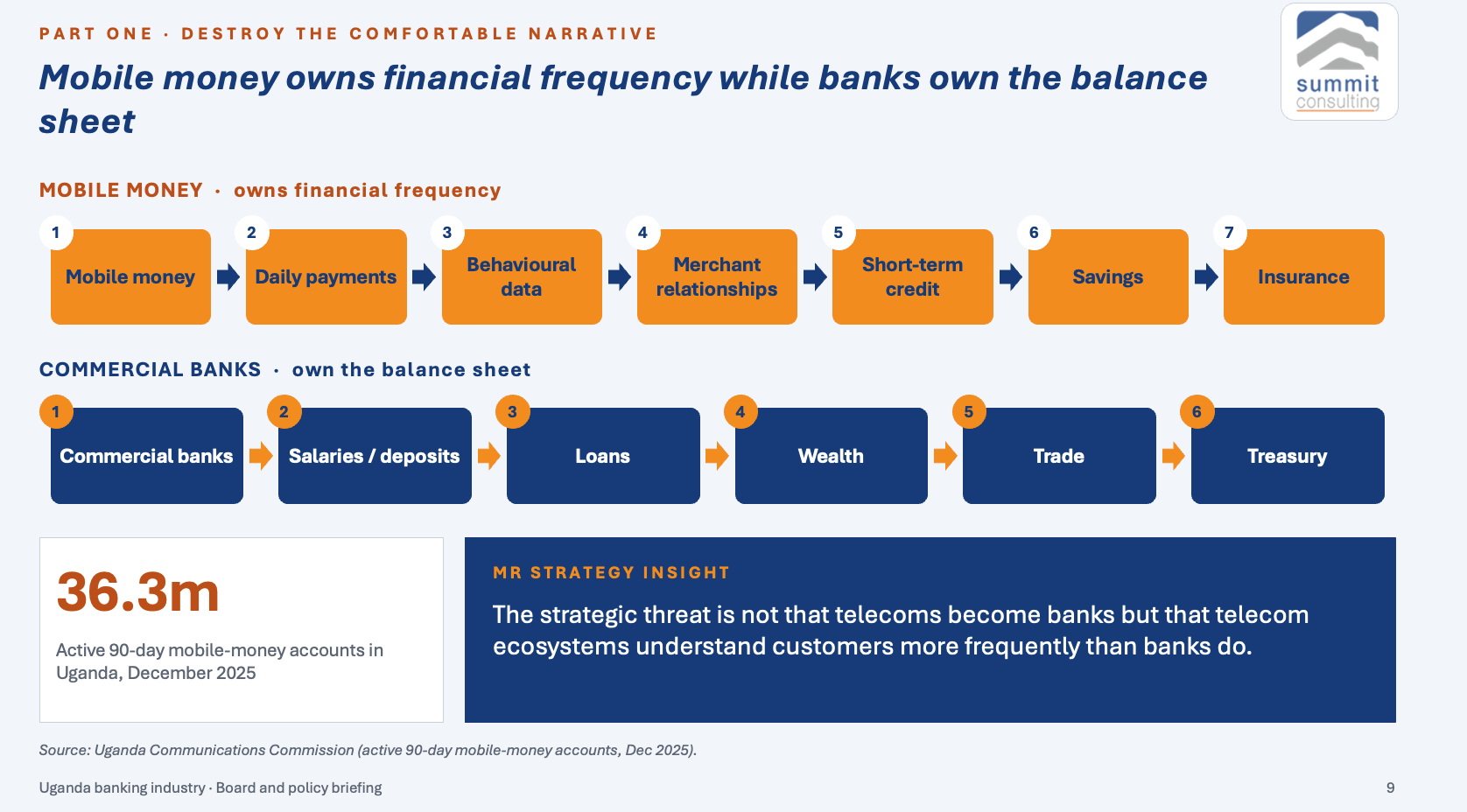
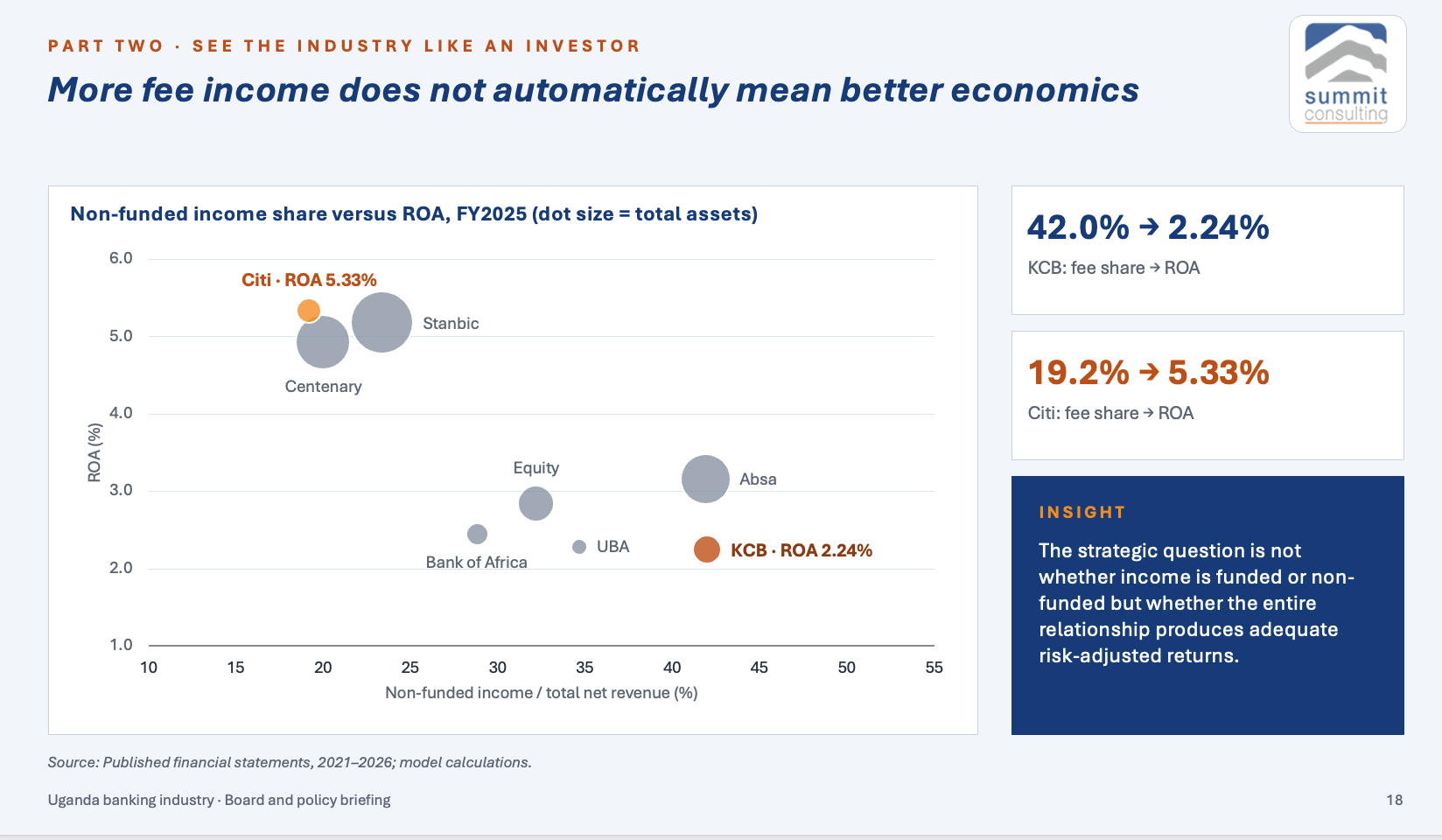
Those five institutions together control nearly two-thirds of the bancassurance business generated through financial institutions. Coincidence? No. The future bank is not selling loans. It is monetising relationships. Deposits provide funding. Payments create frequency. Credit creates spread. Insurance creates commission.
FX monetises trade. Wealth captures surplus liquidity. Merchant acquiring captures commerce. Transaction data improves underwriting. The customer is therefore not a borrower. The customer is an ecosystem. That is why the next competitive fight will be over financial habit, not merely accounts.
Uganda already had 36.3 million active 90-day mobile-money customers at the end of 2025, completing more than 9.1 billion transactions during the year valued at about UGX 365.9 trillion. If a bank’s app is used twice a month while mobile money is used several times a day, the telecom ecosystem owns more of the customer’s behavioural data than the bank. That is the digital challenge executives should be discussing. Not app colours.
ATMs change where the smart banks should hunt
Government wants the economy to grow tenfold toward US$500 billion by 2040, anchored around agro-industrialisation, tourism, minerals and science, technology and innovation. The FY2026/27 budget framework alone proposes UGX 1.47 trillion for agro-industrialisation interventions and identifies finance, processing, storage, certification and market access among the priority areas. This creates enormous banking opportunities.
But boards should avoid another fashionable mistake. Putting “ATMS” into the strategic plan does not create an ATMS strategy.
A bank must decide what it knows. Stanbic can finance infrastructure, large corporates, energy, oil ecosystems and multinational value chains. Centenary can dominate farmers, cooperatives, agro-dealers, rural merchants and small processors.
Absa can build affluent, corporate, wealth and transaction ecosystems around sophisticated customers and supply chains. dfcu can return aggressively to its development-finance DNA in manufacturing, agriculture, infrastructure and productive SMEs. Equity can use mass-market distribution and ecosystem banking to finance farmers, merchants, youth businesses and regional trade. Five banks. Five different ways to play the same national opportunity.
That is strategy.
The boardroom question that exposes weak strategy
There is an exercise I like using in banking strategy discussions.
I put one question on the screen:
If the government stopped offering attractive securities tomorrow, where would you confidently deploy the next UGX 500 billion and still achieve the board’s risk-adjusted return?
Then I listen. A generic answer such as SMEs, agriculture or digital lending tells me the bank does not yet have a strategy.
A serious answer sounds different. It names the customer. The value chain. The cash-flow source. The anchor. The product. The risk signal. The distribution channel. The expected loss. The fee attach. The tenor. And what the bank knows that competitors do not. That is how banking strategy should sound.
What I would demand from the board
Board members should stop accepting loan growth, deposit growth, and profit growth as sufficient evidence of strategic execution.
I would ask management to show
a) the cost and stability of incremental deposits,
b) risk-adjusted return on capital by sector and customer segment,
c) how much of the balance sheet is going into sovereign assets versus productive private credit,
d) cost per customer and transaction before and after digital investment,
e) non-interest revenue per active relationship, and
f) the percentage of lending supported by proprietary transaction or ecosystem information rather than collateral alone.
Those six numbers will tell you far more about the future than a hundred-page strategy deck.
Policy makers also need a different conversation
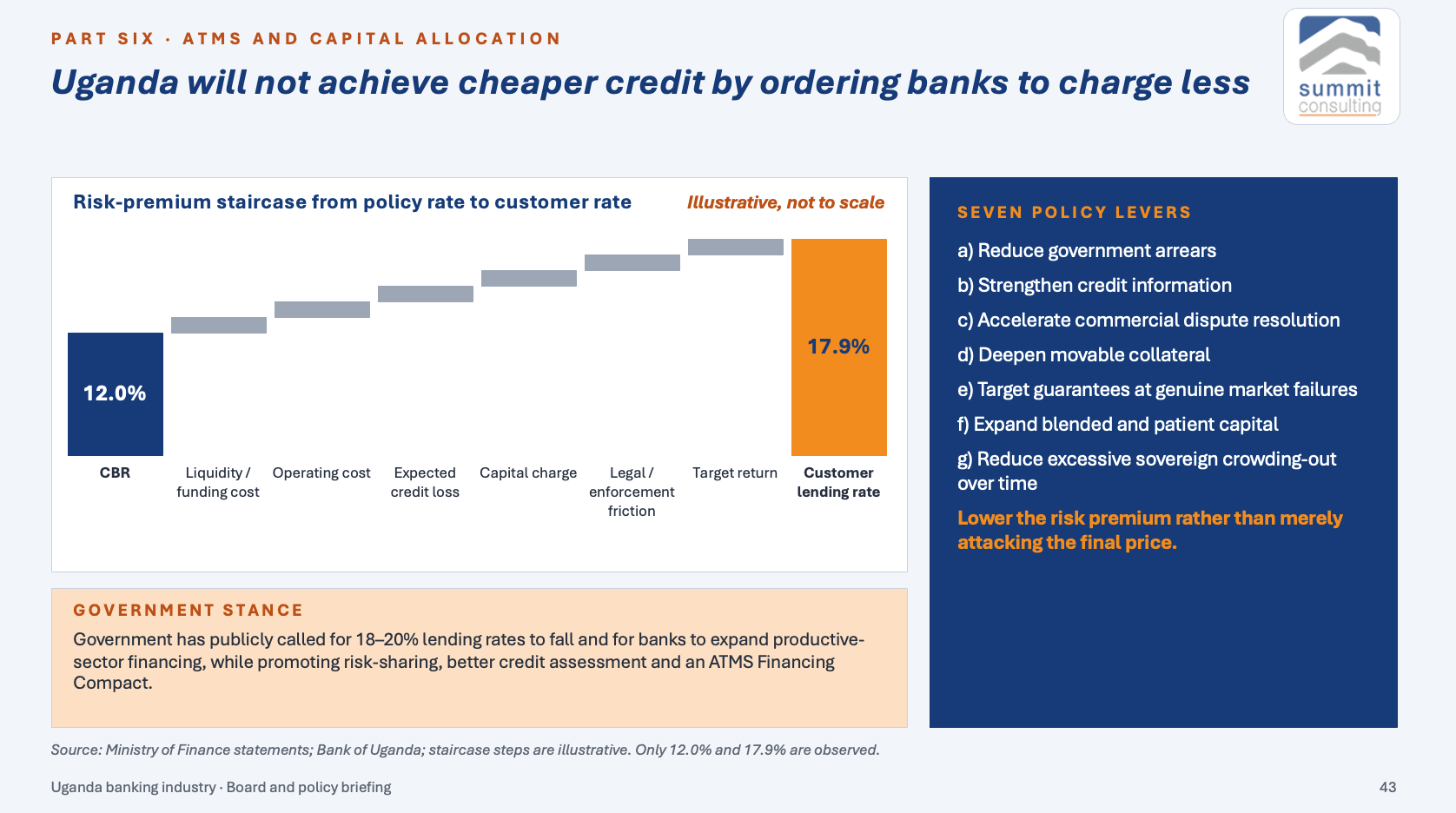
Government is correct to ask banks for cheaper and longer-term credit, but telling banks to lower lending rates without changing the economics of lending will produce speeches rather than transformation. The Finance Ministry itself acknowledges that average lending rates remain around 18 to 20 percent and has called for better data, guarantees and risk-sharing mechanisms.
The policy response should therefore attack the risk premium.
Government payment arrears must fall because a contractor owed by Government quickly becomes a bad loan at a commercial bank. Credit information must become deeper. Movable collateral must become more usable. Guarantees should target information and collateral failures rather than subsidising loans that banks would have written anyway. Commercial disputes must be resolved faster.
Productive-sector data should become more transparent. And Government should progressively reduce the sovereign crowding-out incentives that make Treasury securities structurally attractive relative to private credit. Banks respond to incentives. Change the incentives and behaviour will change.
The top five are not racing toward the same finish line
Stanbic’s task is to convert privilege into productive leadership.
Centenary’s task is to convert customer knowledge into digital operating leverage.
Absa’s task is to convert acquired deposits and wealth relationships into superior economics without importing asset-quality problems.
dfcu’s task is to convert relevance and digital adoption into operating leverage and a clear sector-specialist identity. Equity’s task is to convert financial repair into disciplined renewed growth. That is why I do not believe Uganda has one “best bank”. It has different business models at different points in their strategic cycles.
The board’s job is not to copy the current winner. It is to understand why that bank wins. Because the next five years will punish imitation. When rates are high, sovereign assets are attractive, mobile money owns daily financial behaviour, and ATMs create new sector opportunities, the strongest bank will not be the institution doing the most things.
It will be the institution that knows exactly where it has an unfair information, funding, or distribution advantage and concentrates capital there.
Your dashboard can remain green while that advantage disappears.
So at the next board meeting, before asking whether profit is above budget, ask the simpler question: What do we know, own, or control that will allow this bank to earn superior risk-adjusted returns in 2031 that our competitors cannot easily replicate?
If management cannot answer that clearly, stop admiring the dashboard.
The strategy is already red.
I remain Mr Strategy.
A strong board does not need another retreat where everyone agrees, takes photos and returns to the same problems. It needs a room where the difficult questions are asked, the numbers are interrogated, assumptions are challenged, and the team leaves with clear choices, clear accountabilities and a strategy that can actually be executed.
That is where Mr Strategy comes in.
If your board is preparing for a strategy retreat, board induction, or leadership team-building session, engage Mr Strategy to facilitate a conversation that goes beyond presentations and gets to the real issues shaping performance, risk, culture, and growth.
Expect sharp analysis, practical tools, difficult but necessary questions, and a process designed to move the board from discussion to decision.
For board strategy retreats, board induction and executive team building, invite Mr Strategy to help your leadership team see what others are missing, decide what matters most and align around what must happen next. Comment below or in the inbox.
Are you an EXCO member or board member? Do you need top independent market analysis to make informed decisions? Have Mr Strategy make a board briefing on the state of the market. You can comment below for the complete 47-slide deck briefing. At just a small monthly fee will save lots of money to access top industry insights weekly that will surely earn you 10x in terms of quality decisions. Mr Strategy will also support your strategy execution war rooms to gain an edge against the competition.
0 comments
Leave a comment