
What is your business model? How does your business make money? What are your top three sources of revenue? How scalable are your income sources and your business to tap into all opportunities present?
These and many questions should dominate the Board and senior management agenda. There must be clarity of how your business creates, delivers and sustains value. Let’s explore this in detail.
Your business model
Business or not, you need clarity of how your organization earns revenue. As we explored in the past #winningMindset newsletter, business is about bringing money on the table, and keeping it there.
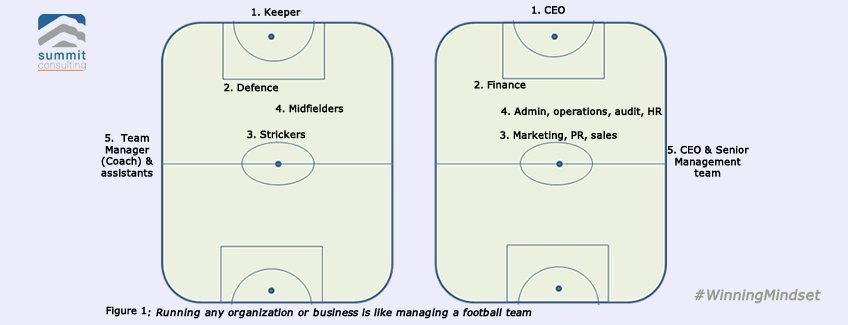
Running any organization or business is like managing a football team. You must be strategic and tactical in your approach as illustrated in figure 1 above.
You need strikers.
In business, these are your front end people. They are involved in branding, public relations, marketing and sales. Each of these does a special, key role.
Branding is about your corporate identity. You need quality graphics and layout to ensure consistent management of your look and feel. Your brand team is responsible for crafting a brand policy: that specifies your logo, color mix, font type and size, Business Cards, Letter head, Website, PowerPoint presentations, email signatures, reports, branding mockups for vehicle, cars, office, cups, company shirts, laptops and all your corporate marketing collateral.
The brand team is so critical to your business as it defines your brand equity and value. Next time you find your logo is squeezed, your staff have different business cards in terms of look and feel and your font type is different, know your brand team is letting you down.
It is the role of the Board to approve the corporate brand policy, from which the brand manual is developed. The board must also review and approve the brand manual. This ensures a right tone at the top, as the board owns corporate reputation and image.
Public relations
This role is essential for public entities and NGO’s or very large multinational companies with a lot of public interest.
The general community is one of the key stakeholders especially for public organizations like utility providers e.g. electricity, water or entities involved in policy oversight like the Central Bank.
The public has many questions that need answers all the time. To ensure consistent communication and clarity of common position, the role of the public relations office cannot be over emphasized. For a large company, the role of this office is to coordinate crisis, manage the media and issue press releases on key issues of interest.
For a small organization or SMEs, the role is a preserve of the CEO or Managing Director. Information once out, is very difficult to control. That is why even sending out emails you need a lot of care. Ensure your staff do not send out emails that might give rise to contractual obligations via email.
Marketing
This is not like sales. They are different. In the #WayofTheGuerrilla, one of Summit Consulting’s sought after training, we say “Marketing is the process of making people squat.”
This is the process of understanding your customer segments, profiling the segments to understand who the customers (buyers) are and consumers (end users), where to find them and the channels to use to get to them. You also must identify the products and services that are ideal for them.
Once you do that, then ensure you find an ideal forum to create awareness of your products/ services to your target prospects. Once your target prospects get to understand what you do, and their pain and the fact that only your products and services are the ideal solution to their pain, you have effectively marketed.
Remember, this process has nothing to do with sales. It has everything to do with promoting your brand awareness and positioning. It is the most ideal to provide quality goods and services they offer. Marketing to many is the most effective strategy.
Sales
Here, you “tap on your prospects to fall over.” If you did great marketing, you left your prospects squatting. When it comes to sales, you visit to close the sale. It is better to sell to one client at a time.
In the business, the striker plays a key role. You need to put your best foot forward. Have a great team of branding experts, PRs, marketers and sales professionals.
Who are your strikers in your business? If they are unable to score, you will experience lots of business challenges. No team wins a match without scoring.
Your business model explains how you will make money. There are several ways to model your business or organization.

So what is your business model?
You need clarity of how your business will make money. What will you sell, to who and how?
What are your revenue sources?
To make money, you must sell something- a product or services. If you are in manufacturing, what kind of products do you make? Are they mass market products, in which case they are lowly priced for the mass market e.g. washing soap, pens, pencils, books etc? Are they highly priced products for the middle class e.g. Apple laptops and phones?
If you are manufacturing to sell to the mass market, you need a key variable- scale.
How do you easily scale your operations, production, sales channels to significantly respond to sudden spikes in market demand? Platform companies like Amazon, Google, Apple, Facebook, Uber, etc have succeeded due to their ability to scale and respond to any customer increase.
As you plan your business, always ask yourself: How can I scale this.
success.



0 comments
Leave a comment