Start typing to search the whole website.

Summit Consulting Ltd
Home
Password Strength Checker Cyber Risk Quick Check Are You Safe Online? Are You Cyber Secure? AML Compliance Quiz Data Privacy and Protection Act Quiz Financial IQ Quiz Culture Audit MS Office & Excel Skills Quiz Risk Management Self-Assessment IFRS 9 Adoption Questionnaire 10-Minute Leadership Presence Self-Assessment Board Diversity Assessment Tool MFA Authentication Quiz Benford Analysis Tool Internal Audit Survey BCP / DR Survey Insurance Fraud Policy Questionnaire Fraud Management Survey Strategy Implementation Effectiveness Survey Boardtool Resources 7 Tools Board Book iShield 360 Project FRONTLINE Report Summit Weekly Newsletters Uganda Banking Report The Human Rights Enforcement Act 2019: A Guide Managing Board Affairs in a New Era Barriers to Effective Strategy Execution 8 Strategies to Overcome Sales Rejections Board Evaluation Tool SummitEthical Board Assessment Tool Board Effectiveness Template Executive Ownership Matrix Chair-CEO Gap Framework The 5-Fit Test for Directors The Promotion Readiness Grid The Accountability Chain The Alignment Grid The Trench Leadership Index The Secretary Power Grid Future Director Matrix Mr Strategy's Compass Card Template Mr Strategy's Culture Health Check Tool The Chair Navigation Compass The Fear Filter Tool Leadership Readiness Assessment Scorecard ERM Accountability Map Template Key Risk Indicator (KRI) Template ICT Asset Register Template Digital Risk Oversight Radar Template Enterprise Risk Management Framework and Internal Audit Program Audit Committee Briefing Report Template Internal Audit Board Briefing Template Fraud Reporting Register Template AI and Machine Learning Risk Governance Assessment Tool Strategic Foresight Audit Tool EXCO Execution Grid SIEM Tool Assessment Criteria Cybersecurity Assessment Tool (ISO 27001 and NIST) iShield 360: Multi-Factor Authentication Tools iShield 360 Cybersecurity Risk Assessment Template iShield 360: DLP System Tool Phishing Awareness Guide Password Security Checklist Black Box Penetration Testing Checklist Penetration Testing Scoping Questionnaire Cyberattack Incident Response Plan (CIRP) Template End-of-session Leadership Transition Evaluation SOC Assessment Survey Cybersecurity Survey Questionnaire IFRS9 Adoption Questionnaire
Insights
Talk to us
+256 782 610333 support@summitcl.com

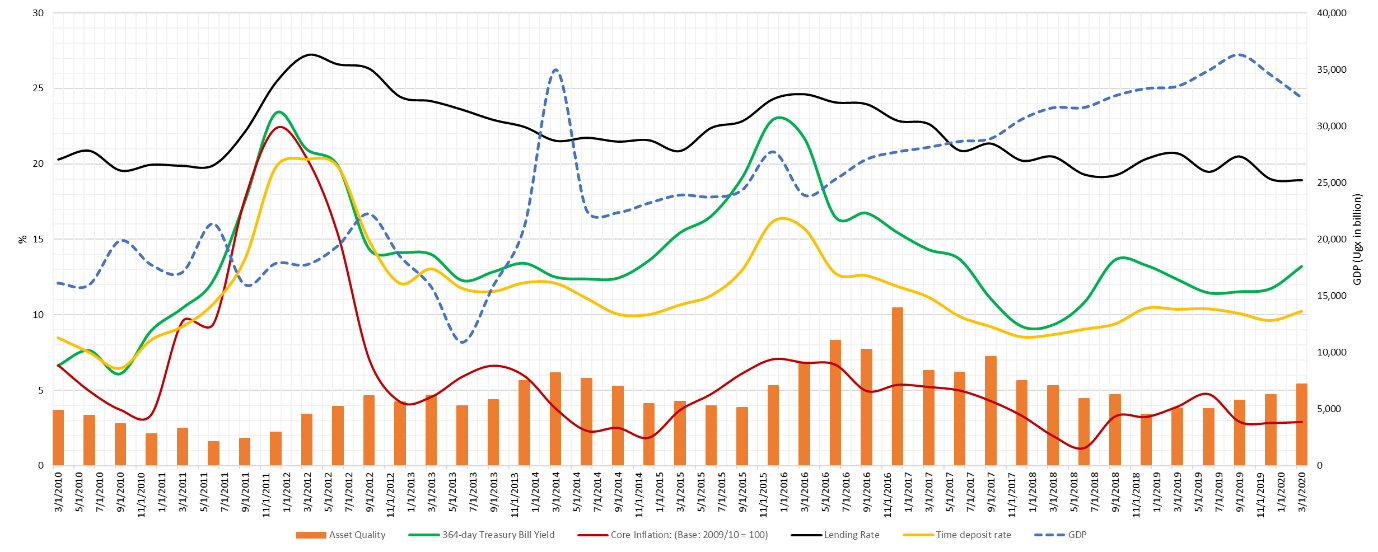
There has been a significant drop in the standard of living with GDP falling by 3.02% year on year from Ugx 33.5 trillion in quarter 4 of 2018/19 to Ugx 32.5 trillion in 2019/20 financial year. GDP dropped 5.86% from January 2019 to March 2020 following the global COVID-19 pandemic that caught the economy by storm. Tax collections on products dropped significantly in quarter 4 of 19/20, contributing 2.36% of the fall in GDP following a 31% drop in revenue contribution.  Donor inflows will drop by more than 47.53% from US$ 207.4 million by May 2020

The biggest driver of the drop in GDP was the services sector that caused 2.55% of the total drop. Uganda’s fixed-income yields and economic indicators follow political cycles, see figure below Can you spot the 2011 elections, 2016 elections?

State of Uganda’s Business Environment
  1. Fixed Income Securities usually bubble before election periods as the government sources funding for elections, particularly the ruling party. Increased fixed income yield attracts funding from financial institutions and other large corporations to purchase these treasury bills for extra interest. However, this affects GDP adversely as the lending rates rise simultaneously to discourage private sector borrowing with a preference for risk-free investments. The lack of capital from loans and advances consequently drops production, thus GDP is affected. Nevertheless, banks still require customer deposits to grow to finance extra investment with rising t-bill rates. They thus increase time deposit rates to attract savings.
  2. Saving increases the flow of funds in the financial system and thus gives banks an extra push to lend to the private sector, though at higher lending rates to cover for the cost of deposits they incur on time deposits to maintain their net interest margins.
  3. Bank asset quality worsens during periods of recession and thus will be a reason for high provisions by year-end 2020. During the period to February 2021, we anticipate a high treasury bill rate that will attract financial institutions to invest at the expense of the private sector, which could continue reporting high default rates and restructuring proposals.

To read more about the;

  • Noteworthy sector highlights
  • Economic dynamics for 2021
  • High-Risk Lending Sectors
  • Microfinance Deposit-Taking Institutions (MDIs),

Download the full Report; Uganda Banking Sector Analysis 2020 below

0 comments

Leave a comment

Keep reading

More from Summit Consulting.