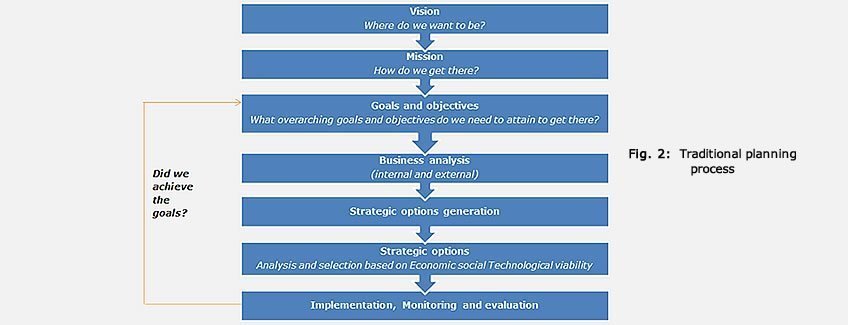
This is the 20th Century. Every Business needs a strategy for the new era. Traditional planning approaches that follow the stages as shown in Fig 2 may not work.
The traditional planning process starts with formulating the vision or “dream” of the business. Leaders usually ask: where do we want to be? After a brainstorming session, a short clear statement articulating the ‘ideal’ and desired future of the business is made. Unfortunately anchoring your strategic planning on an ‘old vision’ is not good as we will explore below.
For an existing business, the vision is usually found in the old literature of the business. There are specific guidelines of what a good vision is and how it should be worked. Many executives take time to ensure they get the working of their vision right.
The mission
Once the vision has been articulated, the strategy team then formulates the mission of the organization by answering the question; how do we get there? Also several guidelines on how to word the mission abound.
One of the key issues that are defined at this stage includes the values to guide the behavior of all stakeholders.
The goals and objectives
At MBA, we learnt that objectives are SMART, Specific, Measurable, Attainable, Realistic and Time bound. So in the traditional way, an organization must set clear goals (that are not SMART); and then respective objectives per goal. The objectives help achieve the set goals.
Once the ‘SMART’ objectives have been formulated, the strategy team then conducts a thorough institutional review using the SWOT model i.e internal and external review.
Review helps identify the internal strengths and weaknesses of the business. The model used here is 6ms, i.e. money, materials, machinery, and man power, make up and markets. For each item, an internal self-examination is made to ascertain the extent the business needs, then money is identified as its weakness. If the company has all the money, it needs for example through a favorable line of credit, and then money may be identified as the strength over the competition.
The idea is to identify all the weaknesses and turn them into strengths. And for the strength, ensure they are leveraged on to grow the business.
Once all the internal resources are carefully analyzed, they are summarized and ranked accordingly as indicated in the table below.

Each of the resources is then reviewed and analyzed. Any capability the company has as needed is considered a strength. The next step is then to explore alternative of optimizing from the strength.
If the capability needed is not available, it is then considered a weakness. Management then has to brainstormhow to convert the weaknesses into strengths and leverage from it.